The bromoalkanes shown below participate in SN1 reactions with the relative rates shown. Explain this trend. relative rate:
Ch. 12 - Substitution and Elimination: Reactions of Haloalkanes

Mullins1st EditionOrganic Chemistry: A Learner Centered ApproachISBN: 9780137566471Non è quello che usi tu?Cambia libro di testo
Tutti i libri di testo
Mullins 1st Edition
Ch. 12 - Substitution and Elimination: Reactions of Haloalkanes
Problema 75
Mullins 1st Edition
Ch. 12 - Substitution and Elimination: Reactions of Haloalkanes
Problema 75Capitolo 11, Problema 75
In this, and previous, chapters, we have seen 1,2-alkyl and 1,2-hydride shifts. If both are possible, as in the carbocation shown, which would you expect to occur? Explain your answer.

Guida verificata passo dopo passo1
Step 1: Analyze the carbocation structure shown in the image. The carbocation is located on a secondary carbon, and there are two possible shifts: a 1,2-hydride shift (path a) and a 1,2-alkyl shift (path b).
Step 2: Understand the purpose of these shifts. Both shifts aim to stabilize the carbocation by moving the positive charge to a more stable position. Stability increases as we move from secondary to tertiary carbocations.
Step 3: Evaluate the 1,2-hydride shift (path a). This shift involves the migration of a hydrogen atom with its bonding electrons to the carbocation center. If this shift results in a tertiary carbocation, it is likely to occur because tertiary carbocations are more stable than secondary ones.
Step 4: Evaluate the 1,2-alkyl shift (path b). This shift involves the migration of an alkyl group with its bonding electrons to the carbocation center. If this shift also results in a tertiary carbocation, it could compete with the hydride shift. However, hydride shifts are generally faster and more favorable due to lower steric hindrance.
Step 5: Conclude that the 1,2-hydride shift (path a) is expected to occur because it is typically faster and leads to a more stable tertiary carbocation. The 1,2-alkyl shift (path b) is less likely unless it provides an even greater stabilization or is sterically favored.

Risposta video verificata per un problema simile:
Questa soluzione video è stata consigliata dai nostri tutor come utile per risolvere questo problema.
Concetti chiave
Ecco i concetti essenziali che devi comprendere per rispondere correttamente alla domanda.
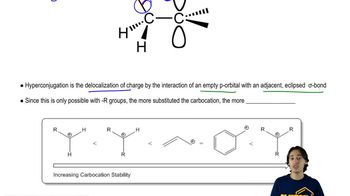
Carbocation Stability
Carbocations are positively charged species that are highly reactive due to the electron deficiency at the positively charged carbon atom. Their stability is influenced by the degree of substitution; tertiary carbocations are more stable than secondary or primary ones due to hyperconjugation and inductive effects from adjacent alkyl groups. Understanding the stability of carbocations is crucial for predicting the preferred rearrangement pathway.
Video consigliato:
Determining Carbocation Stability
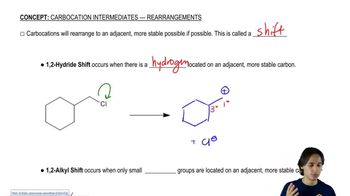
1,2-Alkyl and 1,2-Hydride Shifts
1,2-alkyl shifts involve the migration of an alkyl group from one carbon to an adjacent carbocation, while 1,2-hydride shifts involve the migration of a hydrogen atom. These shifts occur to stabilize the carbocation by forming a more stable carbocation. The preference for one shift over the other depends on the resulting carbocation's stability and the steric and electronic factors involved.
Video consigliato:
Hydride Shift
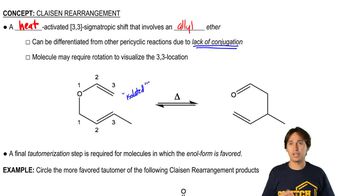
Rearrangement Mechanism
Rearrangement mechanisms in organic chemistry describe how carbocations can undergo structural changes to achieve greater stability. This process often involves the migration of groups or atoms, such as hydrides or alkyl groups, to form a more stable carbocation. The mechanism is influenced by factors such as sterics, electronic effects, and the overall energy of the transition state, which ultimately determines the favored pathway.
Video consigliato:
Definition of Claisen Rearrangement
Pratica correlata
Domanda del libro di testo
1137
views
Domanda del libro di testo
Suggest a mechanism for the following reactions.
(b) Substitution :
920
views
Domanda del libro di testo
Suggest a mechanism for the following reactions.
(a) Substitution:
889
views
Domanda del libro di testo
Of the three possible elimination mechanisms (Figure 12.50), this chapter focused on two of them (E1 and E2). The third possibility occurs in situations like the one below. What makes this mechanism favored under these conditions?
341
views
Domanda del libro di testo
In Chapter 8, we learned about the chemistry of terpenes and the interesting reactions they can undergo. One such reaction is the acid-catalyzed conversion of nerol to terpineol. Suggest a mechanism for this transformation
.
1390
views
Domanda del libro di testo
Suggest a mechanism for the following reactions.
(c) Elimination:
1153
views