Ch. 12 - Substitution and Elimination: Reactions of Haloalkanes
Mullins - Organic Chemistry: A Learner Centered Approach 1st Edition
Mullins1st EditionOrganic Chemistry: A Learner Centered ApproachISBN: 9780137566471Non è quello che usi tu?Cambia libro di testo
Capitolo 11, Problema 12b

Practice your electron-pushing skills by drawing a mechanism for the following SN1 reactions.
(b) Diagram illustrating an SN1 reaction mechanism with reactants, products, and water as a solvent.

Guida verificata passo dopo passo
1
Step 1: Understand the Sₙ1 reaction mechanism. Sₙ1 stands for 'substitution nucleophilic unimolecular,' which involves two steps: (1) the formation of a carbocation intermediate and (2) the nucleophilic attack on the carbocation.
Step 2: Identify the leaving group in the substrate molecule. The leaving group is typically a halide or another group that can stabilize the negative charge after leaving. Draw the substrate and show the bond breaking between the carbon and the leaving group.
Step 3: Illustrate the formation of the carbocation intermediate. After the leaving group departs, the carbon atom bonded to it becomes positively charged. Ensure you consider the stability of the carbocation (e.g., tertiary carbocations are more stable than secondary or primary).
Step 4: Show the nucleophilic attack. The nucleophile (e.g., water, hydroxide ion, or another electron-rich species) will attack the carbocation, forming a new bond. Use curved arrows to represent the movement of electrons during this step.
Step 5: If applicable, include any proton transfer or rearrangement steps to finalize the product. For example, if the nucleophile is water, a proton may need to be removed to yield the final neutral product. Ensure all charges are balanced and the product is correctly drawn.

Risposta video verificata per un problema simile:

Questa soluzione video è stata consigliata dai nostri tutor come utile per risolvere questo problema.
Durata del video:
1m

Concetti chiave

Ecco i concetti essenziali che devi comprendere per rispondere correttamente alla domanda.

Sₙ1 Mechanism

The Sₙ1 (substitution nucleophilic unimolecular) mechanism involves a two-step process where the rate-determining step is the formation of a carbocation intermediate. In this mechanism, the leaving group departs first, creating a positively charged carbocation, which is then attacked by a nucleophile. This mechanism is favored in tertiary substrates due to their ability to stabilize the carbocation.
Video consigliato:
04:32
General Mechanism

Carbocation Stability

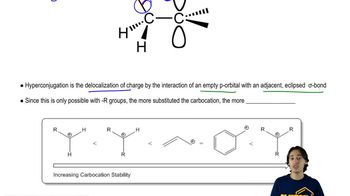
Carbocation stability is crucial in Sₙ1 reactions, as more stable carbocations form more readily. Stability increases with the degree of substitution: tertiary > secondary > primary. Factors such as resonance and inductive effects also play a role in stabilizing carbocations, influencing the reaction pathway and rate.
Video consigliato:
05:58
Determining Carbocation Stability

Nucleophiles

Nucleophiles are species that donate an electron pair to form a chemical bond in a reaction. In Sₙ1 reactions, the nucleophile attacks the carbocation after its formation. The strength and nature of the nucleophile can significantly affect the reaction rate and product distribution, with stronger nucleophiles generally leading to faster reactions.
Video consigliato:
08:27
Nucleophilic Addition