Ch. 12 - Substitution and Elimination: Reactions of Haloalkanes
Mullins - Organic Chemistry: A Learner Centered Approach 1st Edition
Mullins1st EditionOrganic Chemistry: A Learner Centered ApproachISBN: 9780137566471Non è quello che usi tu?Cambia libro di testo
Capitolo 11, Problema 33d

Predict the product of the following substitution reactions, making sure to note whether a rearrangement should occur.
(d)

Guida verificata passo dopo passo
1
Step 1: Identify the type of substitution reaction. Since the solvent is water (H2O), this reaction is likely to proceed via an SN1 mechanism, as water is a polar protic solvent that stabilizes carbocations.
Step 2: Determine the leaving group. The chlorine atom (Cl) is the leaving group, and it will depart to form a carbocation intermediate.
Step 3: Analyze the carbocation intermediate for stability. The initial carbocation formed is a secondary carbocation. Check for possible rearrangements to form a more stable carbocation, such as a tertiary carbocation via a hydride or alkyl shift.
Step 4: Once the most stable carbocation is formed, water (H2O) will act as a nucleophile and attack the carbocation, forming a bond with the positively charged carbon.
Step 5: Deprotonation occurs. The water molecule that bonded to the carbocation will lose a proton (H+) to form the final alcohol product.

Risposta video verificata per un problema simile:

Questa soluzione video è stata consigliata dai nostri tutor come utile per risolvere questo problema.

Concetti chiave

Ecco i concetti essenziali che devi comprendere per rispondere correttamente alla domanda.

Nucleophilic Substitution Reactions

Nucleophilic substitution reactions involve the replacement of a leaving group (like Cl) by a nucleophile (such as H2O). In these reactions, the nucleophile attacks the electrophilic carbon atom bonded to the leaving group, leading to the formation of a new bond and the departure of the leaving group. Understanding the mechanism, whether it follows an SN1 or SN2 pathway, is crucial for predicting the product.
Video consigliato:
01:47
Nucleophiles and Electrophiles can react in Substitution Reactions.

Carbocation Stability

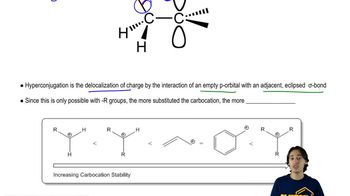
In reactions involving carbocations, the stability of the carbocation intermediate significantly influences the reaction pathway. Tertiary carbocations are more stable than secondary or primary ones due to hyperconjugation and inductive effects. If a carbocation forms during the reaction, it may lead to rearrangements to form a more stable carbocation, which can affect the final product.
Video consigliato:
05:58
Determining Carbocation Stability

Rearrangement in Substitution Reactions

Rearrangement in substitution reactions occurs when a carbocation intermediate can shift to a more stable configuration. This can involve hydride or alkyl shifts, allowing the molecule to achieve a lower energy state. Recognizing when and how rearrangements happen is essential for accurately predicting the final product of the reaction, especially in complex cyclic structures.
Video consigliato:
06:28
Definition of Cope Rearrangement