Ch. 12 - Substitution and Elimination: Reactions of Haloalkanes
Mullins - Organic Chemistry: A Learner Centered Approach 1st Edition
Mullins1st EditionOrganic Chemistry: A Learner Centered ApproachISBN: 9780137566471Non è quello che usi tu?Cambia libro di testo
Capitolo 11, Problema 30b

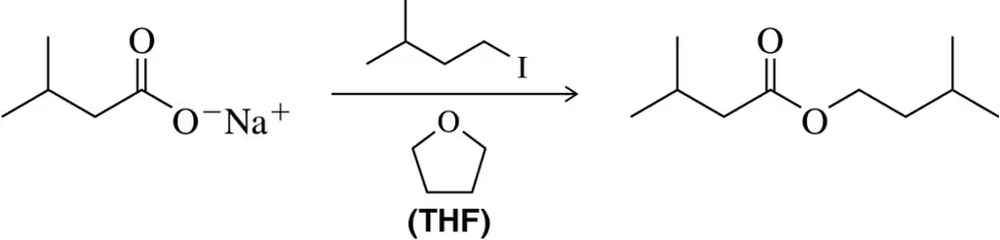
Suggest a mechanism for the following substitution reactions.
(b) Chemical structures illustrating a substitution reaction mechanism with sodium, iodine, and THF as a solvent.

Guida verificata passo dopo passo
1
Identify the type of substitution reaction: Determine whether the reaction is likely to proceed via an SN1 or SN2 mechanism. This depends on factors such as the structure of the substrate (primary, secondary, or tertiary carbon), the strength of the nucleophile, and the solvent used.
Analyze the substrate: If the carbon attached to the leaving group is tertiary or secondary, the reaction may proceed via an SN1 mechanism. If it is primary or methyl, it is more likely to proceed via an SN2 mechanism.
Examine the nucleophile and solvent: A strong nucleophile in a polar aprotic solvent favors an SN2 mechanism, while a weak nucleophile in a polar protic solvent favors an SN1 mechanism.
Propose the mechanism: For an SN1 reaction, the first step involves the departure of the leaving group to form a carbocation intermediate. The nucleophile then attacks the carbocation to form the product. For an SN2 reaction, the nucleophile attacks the substrate in a single concerted step, displacing the leaving group.
Draw the mechanism: Use curved arrows to show the movement of electrons. For SN1, show the formation of the carbocation intermediate and the subsequent attack by the nucleophile. For SN2, show the backside attack of the nucleophile and the simultaneous departure of the leaving group.

Risposta video verificata per un problema simile:

Questa soluzione video è stata consigliata dai nostri tutor come utile per risolvere questo problema.
Durata del video:
1m

Concetti chiave

Ecco i concetti essenziali che devi comprendere per rispondere correttamente alla domanda.

Nucleophilic Substitution Mechanisms

Nucleophilic substitution reactions involve the replacement of a leaving group in a molecule by a nucleophile. The two primary mechanisms are SN1 and SN2. SN1 is a two-step process where the leaving group departs first, forming a carbocation intermediate, followed by nucleophilic attack. In contrast, SN2 is a one-step process where the nucleophile attacks the substrate simultaneously as the leaving group departs, leading to a concerted reaction.
Video consigliato:
01:47
Nucleophiles and Electrophiles can react in Substitution Reactions.

Leaving Groups

A leaving group is an atom or group that can depart from the parent molecule during a substitution reaction. Good leaving groups are typically stable after departure, such as halides (Cl, Br, I) or sulfonate groups (like tosylate). The ability of a leaving group to stabilize its negative charge or form a stable molecule is crucial for the reaction's feasibility and rate.
Video consigliato:
07:22
The 3 important leaving groups to know.

Nucleophiles

Nucleophiles are species that donate an electron pair to form a new bond during a substitution reaction. They can be negatively charged ions (like OH⁻ or CN⁻) or neutral molecules with lone pairs (like water or ammonia). The strength and reactivity of a nucleophile depend on its charge, electronegativity, and steric hindrance, influencing the mechanism and outcome of the substitution reaction.
Video consigliato:
08:27
Nucleophilic Addition