Ch. 12 - Substitution and Elimination: Reactions of Haloalkanes
Mullins - Organic Chemistry: A Learner Centered Approach 1st Edition
Mullins1st EditionOrganic Chemistry: A Learner Centered ApproachISBN: 9780137566471Non è quello che usi tu?Cambia libro di testo
Capitolo 11, Problema 43a

Suggest an appropriate base to synthesize the alkene as the major product from the starting haloalkane.
(a) Flowchart showing a haloalkane with a bromine atom and pathways to synthesize alkenes, with question marks indicating base suggestions.

Guida verificata passo dopo passo
1
Step 1: Understand the reaction type. The synthesis of an alkene from a haloalkane typically involves an elimination reaction (E2 or E1 mechanism). The choice of base is crucial for favoring the elimination pathway over substitution.
Step 2: Analyze the structure of the haloalkane. Determine whether the haloalkane is primary, secondary, or tertiary. This will influence the mechanism (E2 or E1) and the strength of the base required.
Step 3: Consider steric hindrance. If the haloalkane is bulky (e.g., tertiary), a strong, bulky base like potassium tert-butoxide (K⁺[CH₃]₃CO⁻) is often used to favor elimination and minimize substitution.
Step 4: Evaluate the reaction conditions. Strong bases such as sodium hydroxide (NaOH) or potassium hydroxide (KOH) can be used for E2 elimination, while weaker bases may favor E1 elimination under acidic conditions.
Step 5: Select the base based on regioselectivity. If the goal is to form the more substituted alkene (Zaitsev product), use a strong base like NaOH or KOH. If the goal is to form the less substituted alkene (Hofmann product), use a bulky base like potassium tert-butoxide.

Risposta video verificata per un problema simile:

Questa soluzione video è stata consigliata dai nostri tutor come utile per risolvere questo problema.
Durata del video:
3m

Concetti chiave

Ecco i concetti essenziali che devi comprendere per rispondere correttamente alla domanda.

Elimination Reactions

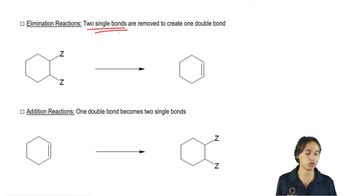
Elimination reactions involve the removal of a leaving group and a hydrogen atom from adjacent carbon atoms, resulting in the formation of a double bond. In the context of haloalkanes, these reactions can lead to the synthesis of alkenes. The most common types of elimination reactions are E1 and E2, which differ in their mechanisms and conditions.
Video consigliato:
00:40
Recognizing Elimination Reactions.

Strong Bases

Strong bases are essential for promoting elimination reactions, particularly E2 mechanisms, where a strong base abstracts a proton while the leaving group departs. Common strong bases include sodium hydroxide (NaOH), potassium tert-butoxide (KOtBu), and sodium ethoxide (NaOEt). The choice of base can influence the regioselectivity and stereochemistry of the resulting alkene.
Video consigliato:
03:10
Monosaccharides - Strong Oxidation (Aldaric Acid)

Zaitsev's Rule

Zaitsev's Rule states that in elimination reactions, the more substituted alkene is typically the major product. This is due to the stability of more substituted alkenes, which are favored thermodynamically. Understanding this rule helps in predicting the outcome of reactions involving haloalkanes and the choice of base can also affect which alkene is formed.
Video consigliato:
01:18
Defining Zaitsev’s Rule