Ch. 13 - Alcohols, Ethers and Related Compounds: Substitution and Elimination
Mullins - Organic Chemistry: A Learner Centered Approach 1st Edition
Mullins1st EditionOrganic Chemistry: A Learner Centered ApproachISBN: 9780137566471Non è quello che usi tu?Cambia libro di testo
Capitolo 12, Problema 100a(ii)

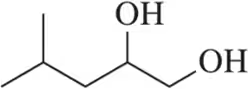
Draw the mechanism for the acid-catalyzed pinacol rearrangement of the following diols.
(a) Structural formula of a diol with two hydroxyl groups on adjacent carbon atoms in a four-carbon chain.

Guida verificata passo dopo passo
1
Identify the diol structure given in the problem. Pinacol rearrangement typically involves a 1,2-diol, so ensure you have the correct starting material.
Protonate one of the hydroxyl groups using the acid catalyst. This step increases the leaving group ability of the hydroxyl group by converting it into a better leaving group, such as water.
Once the hydroxyl group is protonated, it can leave as a water molecule, forming a carbocation at the carbon where the hydroxyl group was attached.
Rearrange the carbocation to form a more stable carbocation. This often involves a 1,2-shift of an alkyl or aryl group adjacent to the carbocation, resulting in a new carbocation at a different position.
Deprotonate the oxonium ion formed after the rearrangement to yield the final ketone product. This step involves the removal of a proton to restore neutrality to the molecule.

Risposta video verificata per un problema simile:

Questa soluzione video è stata consigliata dai nostri tutor come utile per risolvere questo problema.
Durata del video:
7m

Concetti chiave

Ecco i concetti essenziali che devi comprendere per rispondere correttamente alla domanda.

Pinacol Rearrangement

Pinacol rearrangement is a chemical reaction where a 1,2-diol undergoes acid-catalyzed dehydration to form a ketone or aldehyde. The reaction involves the migration of an alkyl group and is typically initiated by protonation of one of the hydroxyl groups, leading to the formation of a carbocation intermediate.
Video consigliato:
06:08
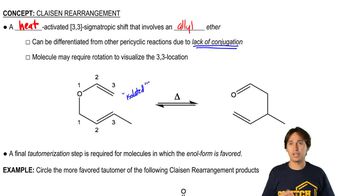
Definition of Claisen Rearrangement

Carbocation Stability

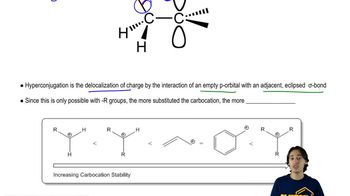
Carbocation stability is crucial in organic reactions, including rearrangements. In pinacol rearrangement, the formation of a stable carbocation intermediate is essential for the migration step. Stability is influenced by factors such as hyperconjugation and resonance, with tertiary carbocations generally being more stable than secondary or primary ones.
Video consigliato:
05:58
Determining Carbocation Stability

Acid Catalysis

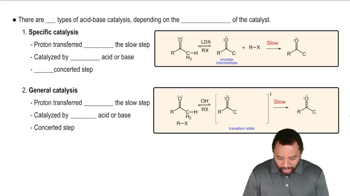
Acid catalysis involves the use of an acid to increase the rate of a chemical reaction. In the pinacol rearrangement, the acid protonates the hydroxyl group, facilitating the formation of a carbocation. This protonation step is critical as it initiates the rearrangement process, allowing the subsequent migration and dehydration steps to occur.
Video consigliato:
Percorso guidato
2:50
Acid-Base Catalysis Concept 3