

Ch. 16 - Metals in Organic Chemistry
Mullins - Organic Chemistry: A Learner Centered Approach 1st Edition
Mullins1st EditionOrganic Chemistry: A Learner Centered ApproachISBN: 9780137566471Non è quello che usi tu?Cambia libro di testo
Capitolo 15, Problema 12a

Predict the product of the following aldehyde and ketone addition reactions.
(a) Chemical reaction diagram showing an aldehyde reacting with lithium in THF, followed by quenching with H3O+.

Guida verificata passo dopo passo
1
Identify the reactants: The image shows a cyclopentane ring with an aldehyde group. The reagent is an organolithium compound, specifically butyllithium (LiC4H9), in THF solvent, followed by an acid quench (H3O+).
Understand the reaction type: This is a nucleophilic addition reaction where the organolithium reagent acts as a nucleophile, attacking the electrophilic carbonyl carbon of the aldehyde.
Describe the mechanism: The butyllithium reagent will donate its butyl group to the carbonyl carbon, breaking the C=O double bond and forming an alkoxide intermediate.
Consider the quenching step: The alkoxide intermediate is then protonated by the acid (H3O+), converting it into an alcohol.
Predict the product: The final product will be a secondary alcohol, where the original aldehyde carbon now bears a hydroxyl group and the butyl group from the organolithium reagent.

Risposta video verificata per un problema simile:

Questa soluzione video è stata consigliata dai nostri tutor come utile per risolvere questo problema.
Durata del video:
3m

Concetti chiave

Ecco i concetti essenziali che devi comprendere per rispondere correttamente alla domanda.

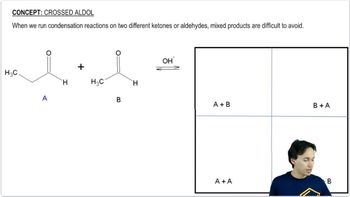
Aldol Condensation

Aldol condensation is a reaction between aldehydes or ketones that contain alpha-hydrogens, leading to the formation of β-hydroxy aldehydes or ketones. This reaction involves the nucleophilic addition of an enolate ion to a carbonyl carbon, followed by dehydration to yield an α,β-unsaturated carbonyl compound. Understanding this mechanism is crucial for predicting the products of reactions involving aldehydes and ketones.
Video consigliato:
09:51
Crossed Aldol

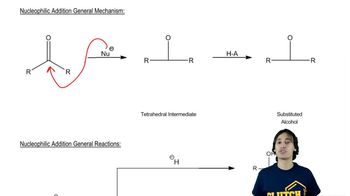
Nucleophilic Addition

Nucleophilic addition is a fundamental reaction in organic chemistry where a nucleophile attacks an electrophilic carbon atom in a carbonyl group. In the context of aldehydes and ketones, this process leads to the formation of alcohols or other functional groups. Recognizing the role of nucleophiles and electrophiles in these reactions is essential for predicting the outcome of the addition reactions.
Video consigliato:
08:27
Nucleophilic Addition

Reaction Mechanism

A reaction mechanism describes the step-by-step sequence of elementary reactions by which overall chemical change occurs. Understanding the mechanism of aldehyde and ketone reactions, including the formation of intermediates and transition states, is vital for predicting the final products. This knowledge allows chemists to anticipate how different conditions or reactants will influence the reaction outcome.
Video consigliato:
02:16
Heck Reaction Mechanism