Ch. 17 - Carbonyl Addition Reactions: Aldehydes and Ketones
Mullins - Organic Chemistry: A Learner Centered Approach 1st Edition
Mullins1st EditionOrganic Chemistry: A Learner Centered ApproachISBN: 9780137566471Non è quello che usi tu?Cambia libro di testo
Capitolo 16, Problema 23a

For each of the following carbonyl addition reactions, would you expect a racemic mixture or a mixture enriched in one stereoisomer? In each case, draw both possible stereoisomeric products.
(a) Chemical reaction diagram showing carbonyl compound reacting with MgBr and H2O, producing an alcohol with stereoisomers.

Guida verificata passo dopo passo
1
Identify the type of reaction: The image shows a Grignard reaction, where a Grignard reagent (ethyl magnesium bromide) is added to a ketone (butanone) followed by an acid quench.
Understand the mechanism: The Grignard reagent acts as a nucleophile, attacking the electrophilic carbonyl carbon of the ketone, forming a tetrahedral intermediate.
Consider stereochemistry: The attack of the Grignard reagent on the planar carbonyl group can occur from either side, leading to the formation of two possible stereoisomers.
Draw the products: The reaction will produce two stereoisomers, which are enantiomers. Draw both possible configurations of the newly formed chiral center.
Determine the mixture type: Since the attack can occur from either side with equal probability, a racemic mixture of the two enantiomers is expected.

Risposta video verificata per un problema simile:

Questa soluzione video è stata consigliata dai nostri tutor come utile per risolvere questo problema.

Concetti chiave

Ecco i concetti essenziali che devi comprendere per rispondere correttamente alla domanda.

Carbonyl Chemistry

Carbonyl compounds, characterized by a carbon-oxygen double bond (C=O), are key functional groups in organic chemistry. They can undergo various reactions, including nucleophilic addition, where a nucleophile attacks the electrophilic carbon atom. Understanding the reactivity and properties of carbonyls is essential for predicting the outcomes of addition reactions.
Video consigliato:
04:20
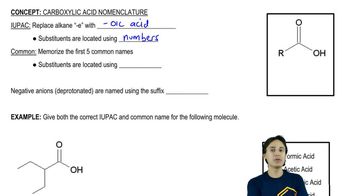
Carboxylic Acids Nomenclature

Stereochemistry

Stereochemistry involves the study of the spatial arrangement of atoms in molecules and how this affects their chemical behavior. In carbonyl addition reactions, the formation of chiral centers can lead to the creation of stereoisomers. Recognizing whether a reaction produces a racemic mixture or isomerically enriched products is crucial for understanding the stereochemical outcome.
Video consigliato:
Percorso guidato
1:38
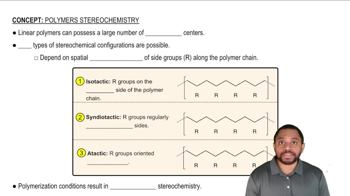
Polymer Stereochemistry Concept 1

Nucleophilic Addition Mechanism

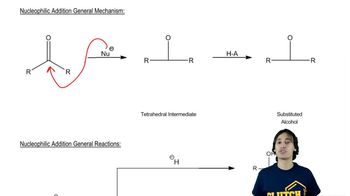
The nucleophilic addition mechanism describes how a nucleophile attacks the electrophilic carbon of a carbonyl compound, leading to the formation of an alkoxide intermediate. Depending on the symmetry of the carbonyl and the nature of the nucleophile, this process can yield either a racemic mixture of products or a predominant stereoisomer. Analyzing the mechanism helps predict the stereochemical results of the reaction.
Video consigliato:
08:27
Nucleophilic Addition