
Ch. 23 - Benzene 1: Aromatic Stability and Substitution Reactions
Mullins - Organic Chemistry: A Learner Centered Approach 1st Edition
Mullins1st EditionOrganic Chemistry: A Learner Centered ApproachISBN: 9780137566471Non è quello che usi tu?Cambia libro di testo
Capitolo 22, Problema 80

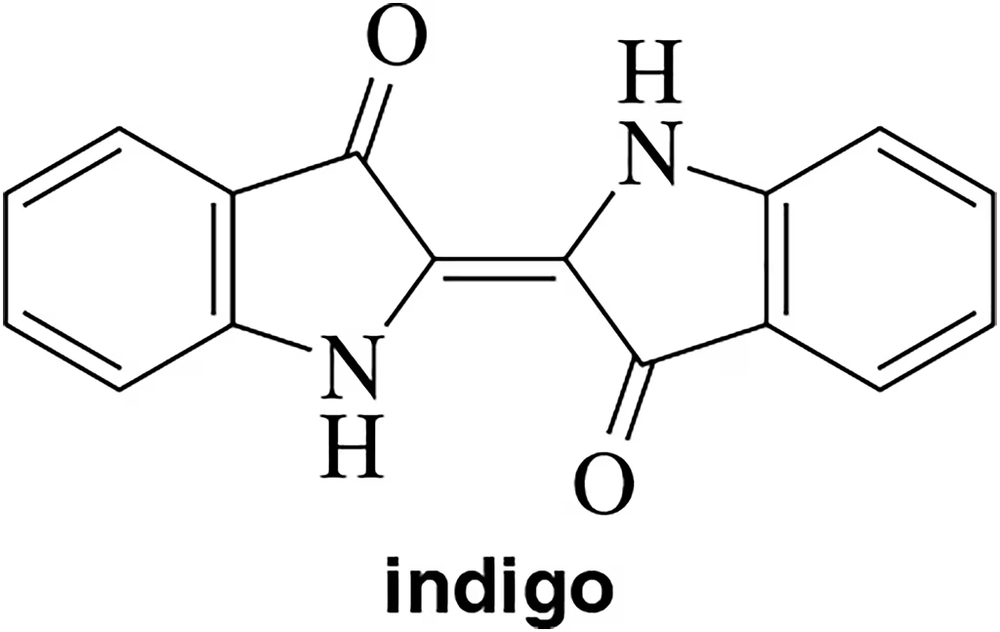
Indigo is a dye that was originally isolated from coal tar. In 1905, Johann Friedrich Wilhelm Adolf von Baeyer won a Nobel Prize for a method that allowed indigo to be isolated from plants [a green chemist ahead of his time.] If you nitrated indigo using the reaction learned in this chapter, at which carbon would you expect the nitro group to attach?
Chemical structure of indigo, a dye, featuring two fused aromatic rings and labeled with the name "indigo."

Guida verificata passo dopo passo
1
Identify the structure of indigo from the image. Indigo is composed of two indole units connected by a double bond. Each indole unit consists of a benzene ring fused to a five-membered nitrogen-containing ring.
Understand the concept of nitration. Nitration is an electrophilic aromatic substitution reaction where a nitro group (NO2) is introduced to an aromatic ring, typically using a mixture of concentrated nitric acid and sulfuric acid.
Determine the most reactive site for electrophilic substitution on the indigo molecule. In aromatic systems, the most electron-rich positions are typically the most reactive towards electrophiles. In indigo, the electron-donating effect of the nitrogen atom in the indole ring increases the electron density on the benzene ring.
Consider the directing effects of substituents. The nitrogen atom in the indole ring is an ortho/para director, meaning it will direct the incoming nitro group to the ortho or para positions relative to itself. However, due to steric hindrance and resonance stabilization, the para position (relative to the nitrogen) is often more favorable.
Predict the position of nitration. Based on the structure of indigo and the directing effects of the nitrogen atom, the nitro group is most likely to attach at the para position of the benzene ring in the indole unit, which is the position opposite to the nitrogen atom in the five-membered ring.

Risposta video verificata per un problema simile:

Questa soluzione video è stata consigliata dai nostri tutor come utile per risolvere questo problema.

Concetti chiave

Ecco i concetti essenziali che devi comprendere per rispondere correttamente alla domanda.

Electrophilic Aromatic Substitution

Electrophilic aromatic substitution (EAS) is a fundamental reaction in organic chemistry where an electrophile replaces a hydrogen atom on an aromatic ring. In the case of nitration, the nitronium ion (NO2+) acts as the electrophile. Understanding EAS is crucial for predicting where the nitro group will attach on indigo, as the stability of the resulting intermediates and the directing effects of substituents influence the reaction outcome.
Video consigliato:
03:07
EAS Review

Aromaticity and Stability

Aromatic compounds, like indigo, exhibit unique stability due to their cyclic, planar structure and delocalized π-electrons, which follow Huckel's rule (4n + 2 π-electrons). This stability affects the reactivity of the compound during electrophilic substitution reactions. The position of substituents on the aromatic ring can either enhance or diminish this stability, guiding where new groups, such as nitro groups, will preferentially attach.
Video consigliato:
08:19
Intro to Aromaticity

Ortho/Para vs. Meta Directing Effects

In electrophilic aromatic substitution, substituents on the aromatic ring can be classified as ortho/para-directing or meta-directing based on their electronic effects. Electron-donating groups typically direct incoming electrophiles to the ortho and para positions, while electron-withdrawing groups direct them to the meta position. Understanding these directing effects is essential for predicting the site of nitration on indigo, which has existing substituents that influence the reaction.
Video consigliato:
04:42
Ortho, Para major products