Ch. 23 - Benzene 1: Aromatic Stability and Substitution Reactions
Mullins - Organic Chemistry: A Learner Centered Approach 1st Edition
Mullins1st EditionOrganic Chemistry: A Learner Centered ApproachISBN: 9780137566471Non è quello che usi tu?Cambia libro di testo
Capitolo 22, Problema 40b

Predict the major product of the following electrophilic aromatic substitution reactions.
(b) Chemical structure showing a benzene ring with a sulfur substituent and a reaction arrow indicating electrophilic aromatic substitution.

Guida verificata passo dopo passo
1
Identify the type of reaction: The reaction shown is an electrophilic aromatic substitution (EAS) where a sulfonation reaction is taking place. The electrophile in this reaction is the sulfur trioxide (SO₃) in the presence of sulfuric acid (H₂SO₄).
Determine the directing effects of the substituent: The substituent on the benzene ring is a thioether group (S-CH₃). This group is an ortho/para director due to the lone pair of electrons on the sulfur atom, which can donate electron density into the benzene ring through resonance.
Predict the position of substitution: Since the thioether group is an ortho/para director, the incoming electrophile (SO₃) will preferentially attack the ortho and para positions relative to the sulfur atom on the benzene ring.
Consider steric and electronic factors: The para position is often favored over the ortho position due to less steric hindrance, making it the more likely site for substitution.
Draw the major product: The major product will be the para-substituted sulfonic acid derivative, where the SO₃H group is added to the para position relative to the thioether group on the benzene ring.

Risposta video verificata per un problema simile:

Questa soluzione video è stata consigliata dai nostri tutor come utile per risolvere questo problema.
Durata del video:
2m

Concetti chiave

Ecco i concetti essenziali che devi comprendere per rispondere correttamente alla domanda.

Electrophilic Aromatic Substitution (EAS)

Electrophilic Aromatic Substitution is a reaction where an electrophile replaces a hydrogen atom on an aromatic ring. The reaction involves the formation of a highly reactive carbocation intermediate, known as the sigma complex, which is stabilized by resonance. The final step is the deprotonation to restore aromaticity, resulting in the substitution of the electrophile onto the ring.
Video consigliato:
03:07
EAS Review

Sulfonation Reaction

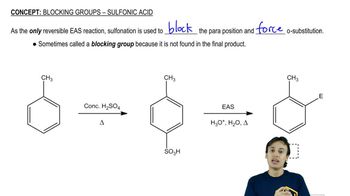
Sulfonation is a type of electrophilic aromatic substitution where sulfur trioxide (SO3) acts as the electrophile, typically in the presence of sulfuric acid (H2SO4). This reaction introduces a sulfonic acid group (SO3H) onto the aromatic ring. The process is reversible, and the position of substitution is influenced by existing substituents on the ring, which can direct the incoming group to ortho, meta, or para positions.
Video consigliato:
04:33
Forcing Ortho substitution

Directing Effects of Substituents

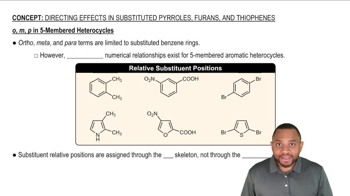
Substituents on an aromatic ring can influence the position of incoming electrophiles during EAS reactions. Electron-donating groups, like alkyl or methoxy groups, typically direct electrophiles to ortho and para positions, while electron-withdrawing groups, such as nitro or carbonyl groups, direct them to the meta position. The sulfur substituent in the given structure is an electron-donating group, which will direct the sulfonation to the ortho and para positions.
Video consigliato:
Percorso guidato
2:02
Directing Effects in Substituted Pyrroles, Furans, and Thiophenes Concept 1