Ch. 23 - Benzene 1: Aromatic Stability and Substitution Reactions
Mullins - Organic Chemistry: A Learner Centered Approach 1st Edition
Mullins1st EditionOrganic Chemistry: A Learner Centered ApproachISBN: 9780137566471Non è quello che usi tu?Cambia libro di testo
Capitolo 22, Problema 32d

Predict the product of the following Friedel–Crafts alkylation reactions. Assume only one alkyl group adds in each case.
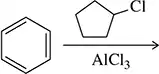
(d) Benzene structure on the left, cyclopentane with a chlorine substituent on the right, with AlCl3 as a catalyst.

Guida verificata passo dopo passo
1
Identify the reactants: The reaction involves benzene and chlorocyclopentane in the presence of aluminum chloride (AlCl₃) as a catalyst.
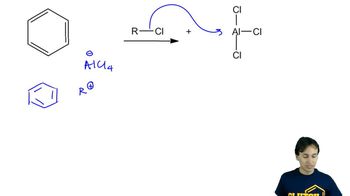
Understand the mechanism: Friedel-Crafts alkylation involves the formation of a carbocation intermediate. The chlorine atom in chlorocyclopentane will leave, forming a cyclopentyl carbocation.
Consider carbocation stability: The cyclopentyl carbocation is relatively stable and will act as the electrophile in the reaction.
Electrophilic aromatic substitution: The cyclopentyl carbocation will attack the benzene ring, forming a sigma complex (arenium ion) and eventually leading to the substitution of a hydrogen atom on the benzene ring with the cyclopentyl group.
Predict the product: The final product will be cyclopentylbenzene, where the cyclopentyl group is attached to the benzene ring.

Risposta video verificata per un problema simile:

Questa soluzione video è stata consigliata dai nostri tutor come utile per risolvere questo problema.

Concetti chiave

Ecco i concetti essenziali che devi comprendere per rispondere correttamente alla domanda.

Friedel-Crafts Alkylation

Friedel-Crafts alkylation is a reaction that introduces an alkyl group into an aromatic ring using an alkyl halide and a Lewis acid catalyst, typically aluminum chloride (AlCl3). This electrophilic substitution reaction allows for the formation of new carbon-carbon bonds, enhancing the complexity of aromatic compounds. However, it can lead to polysubstitution and rearrangements, so careful control of conditions is necessary.
Video consigliato:
06:30
Friedel-Crafts Alkylation

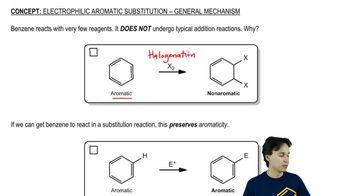
Electrophilic Aromatic Substitution

Electrophilic aromatic substitution (EAS) is a fundamental reaction mechanism in organic chemistry where an electrophile replaces a hydrogen atom on an aromatic ring. The aromatic system's electron-rich nature makes it susceptible to attack by electrophiles, leading to the formation of a sigma complex. This mechanism is crucial for understanding how substituents affect the reactivity and orientation of further substitutions on the aromatic ring.
Video consigliato:
03:07
EAS Review

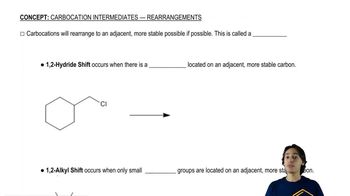
Rearrangement of Carbocations

In Friedel-Crafts reactions, the formation of carbocations is a key step, and these intermediates can undergo rearrangement to form more stable structures. For instance, if a secondary or tertiary carbocation is formed, it may rearrange to a more stable tertiary carbocation before reacting with the aromatic ring. Understanding carbocation stability and rearrangement is essential for predicting the products of alkylation reactions.
Video consigliato:
00:47
Understanding why carbocations shift.