Ch. 23 - Benzene 1: Aromatic Stability and Substitution Reactions
Mullins - Organic Chemistry: A Learner Centered Approach 1st Edition
Mullins1st EditionOrganic Chemistry: A Learner Centered ApproachISBN: 9780137566471Non è quello che usi tu?Cambia libro di testo
Capitolo 22, Problema 12

Which of the following concerted reactions would have a more stable transition state? Why?

Guida verificata passo dopo passo
1
Identify the type of reaction depicted in each image. Both reactions are examples of pericyclic reactions, specifically cycloaddition reactions. The first image shows a Diels-Alder reaction, while the second image shows a [2+2] cycloaddition.
Consider the molecular orbitals involved in each reaction. The Diels-Alder reaction involves a diene and a dienophile, which typically have favorable orbital interactions due to the overlap of the highest occupied molecular orbital (HOMO) of the diene and the lowest unoccupied molecular orbital (LUMO) of the dienophile.
Analyze the symmetry and energy of the transition states. The Diels-Alder reaction generally has a more stable transition state due to the favorable overlap of orbitals and the formation of a six-membered ring, which is energetically favorable.
Evaluate the second reaction, the [2+2] cycloaddition. This reaction often has less favorable orbital interactions because it involves the overlap of two π systems, which can lead to higher energy and less stable transition states.
Conclude that the Diels-Alder reaction is likely to have a more stable transition state due to the favorable orbital interactions and the formation of a six-membered ring, which is typically more stable than the four-membered ring formed in the [2+2] cycloaddition.

Risposta video verificata per un problema simile:

Questa soluzione video è stata consigliata dai nostri tutor come utile per risolvere questo problema.

Concetti chiave

Ecco i concetti essenziali che devi comprendere per rispondere correttamente alla domanda.

Concerted Reactions

Concerted reactions are chemical reactions where all bond-breaking and bond-forming processes occur simultaneously in a single step. This type of reaction does not involve any intermediates, and the transition state is the highest energy point along the reaction pathway. Understanding the concerted nature of a reaction is crucial for analyzing its mechanism and stability.
Video consigliato:
07:37
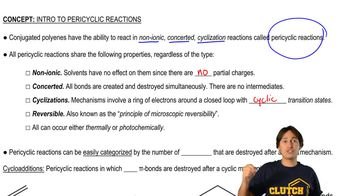
Properties and Types of Pericyclic Reactions

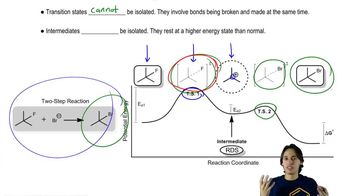
Transition State Stability

The stability of a transition state in a chemical reaction is influenced by factors such as steric hindrance, electronic effects, and the degree of bond formation and breaking. A more stable transition state generally corresponds to a lower activation energy, making the reaction more favorable. In concerted reactions, the transition state stability is critical in determining the reaction's feasibility and rate.
Video consigliato:
06:55
Intermediates vs. Transition States

Pericyclic Reactions

Pericyclic reactions are a class of concerted reactions characterized by a cyclic redistribution of bonding electrons through a transition state. These reactions include cycloadditions, electrocyclic reactions, and sigmatropic rearrangements. The stability of the transition state in pericyclic reactions is often analyzed using orbital symmetry considerations, such as the Woodward-Hoffmann rules, which predict the feasibility of the reaction based on the conservation of orbital symmetry.
Video consigliato:
07:37
Properties and Types of Pericyclic Reactions