Ch. 24 - Benzene 2: Reactions Influenced by the Aromatic Ring
Mullins - Organic Chemistry: A Learner Centered Approach 1st Edition
Mullins1st EditionOrganic Chemistry: A Learner Centered ApproachISBN: 9780137566471Non è quello che usi tu?Cambia libro di testo
Capitolo 23, Problema 34k

Predict the product(s) of the following reactions.
(k) Chemical structure of an ether with a reaction arrow indicating hydrogenation using H2 and Pd/C catalyst.

Guida verificata passo dopo passo
1
Identify the functional groups present in the starting material. The molecule contains an ether linkage (R-O-R') and a cyclopentane ring.
Recognize the reagents used in the reaction. The presence of H2 and Pd/C indicates a catalytic hydrogenation reaction, which typically reduces double bonds or other unsaturated systems.
Consider the stability of the ether linkage under the reaction conditions. Ethers are generally stable to hydrogenation, so the ether bond is unlikely to be cleaved.
Evaluate the potential sites of hydrogenation. Since the molecule does not contain any double or triple bonds, the reaction may not proceed as typical hydrogenation.
Conclude that the reaction conditions may not significantly alter the structure of the starting material, as there are no unsaturated bonds to reduce.

Risposta video verificata per un problema simile:

Questa soluzione video è stata consigliata dai nostri tutor come utile per risolvere questo problema.
Durata del video:
4m

Concetti chiave

Ecco i concetti essenziali che devi comprendere per rispondere correttamente alla domanda.

Hydrogenation

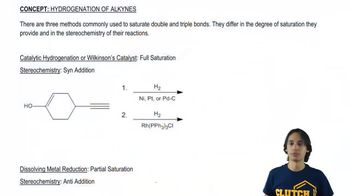
Hydrogenation is a chemical reaction that involves the addition of hydrogen (H2) to a compound, typically in the presence of a catalyst such as palladium on carbon (Pd/C). This process is commonly used to reduce or saturate organic compounds, such as converting alkenes to alkanes. In the context of ethers, hydrogenation generally does not affect the ether linkage unless specific conditions are met.
Video consigliato:
00:48
The definition of hydrogenation.

Catalysis by Pd/C

Palladium on carbon (Pd/C) is a widely used catalyst in organic chemistry for hydrogenation reactions. It facilitates the addition of hydrogen to unsaturated bonds, such as double or triple bonds, under mild conditions. Pd/C is particularly effective due to its high surface area and ability to adsorb hydrogen, making it a versatile catalyst for various reduction reactions.
Video consigliato:
Percorso guidato
2:31
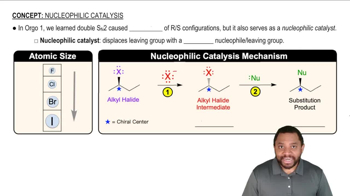
Nucleophilic Catalysis Concept 1

Stability of Ethers

Ethers are generally stable compounds that resist many types of chemical reactions, including hydrogenation. The ether linkage (C-O-C) is not typically affected by hydrogenation under standard conditions, as it lacks the unsaturated bonds that are usually targeted by such reactions. This stability is due to the strong C-O bond and the lack of reactive sites in the ether structure.
Video consigliato:
03:43
The radical stability trend.