Ch. 3 - Alkanes and Cycloalkanes: Properties and Conformational Analysis
Mullins - Organic Chemistry: A Learner Centered Approach 1st Edition
Mullins1st EditionOrganic Chemistry: A Learner Centered ApproachISBN: 9780137566471Non è quello che usi tu?Cambia libro di testo
Capitolo 2, Problema 32a

Name the following cycloalkanes using the IUPAC system of nomenclature. [Hint: Each molecule exemplifies one of the cycloalkane nomenclature rules in Table 3.10.]
(a) rule 1
Diagram of cycloalkanes for IUPAC naming practice, illustrating nomenclature rules with labeled molecular structures.

Guida verificata passo dopo passo
1
Identify the parent cycloalkane: Count the number of carbons in the ring structure to determine the base name of the cycloalkane. For example, a ring with 3 carbons is cyclopropane, 4 carbons is cyclobutane, and so on.
Apply Rule 1: If there is only one substituent on the cycloalkane, there is no need to number the ring. The substituent is simply named as a prefix to the parent cycloalkane.
Determine the substituent: Identify the group attached to the cycloalkane ring. For example, if a methyl group (-CH₃) is attached, it will be named as 'methyl'.
Combine the substituent and parent name: Write the name of the substituent followed by the name of the parent cycloalkane. For example, if a methyl group is attached to a cyclopentane ring, the name would be 'methylcyclopentane'.
Double-check for any additional rules: Ensure that there are no other substituents or special cases that might require further numbering or naming adjustments.

Risposta video verificata per un problema simile:

Questa soluzione video è stata consigliata dai nostri tutor come utile per risolvere questo problema.
Durata del video:
2m

Concetti chiave

Ecco i concetti essenziali che devi comprendere per rispondere correttamente alla domanda.

Cycloalkanes

Cycloalkanes are saturated hydrocarbons that contain carbon atoms arranged in a ring structure. They follow the general formula CnH2n, where n is the number of carbon atoms. Common examples include cyclopropane, cyclobutane, and cyclohexane. Understanding their structure is essential for applying nomenclature rules.
Video consigliato:
01:11
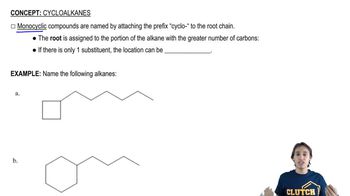
How to find the root name for cycloalkanes

IUPAC Nomenclature

The International Union of Pure and Applied Chemistry (IUPAC) provides a systematic method for naming chemical compounds. For cycloalkanes, the naming involves identifying the number of carbon atoms in the ring and using the prefix 'cyclo-' followed by the appropriate alkane name. This ensures clarity and consistency in chemical communication.
Video consigliato:
03:43
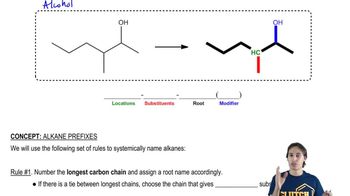
The different parts of an IUPAC name

Nomenclature Rules for Cycloalkanes

Cycloalkane nomenclature follows specific rules, such as identifying the ring structure and determining the longest continuous carbon chain. The first rule often involves naming the cycloalkane based on the number of carbon atoms in the ring. Understanding these rules is crucial for accurately naming the compounds presented in the question.
Video consigliato:
01:11
How to find the root name for cycloalkanes