Ch. 4 - Acids and Bases/Electron Flow
Mullins - Organic Chemistry: A Learner Centered Approach 1st Edition
Mullins1st EditionOrganic Chemistry: A Learner Centered ApproachISBN: 9780137566471Non è quello che usi tu?Cambia libro di testo
Capitolo 3, Problema 9a

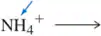
What is the conjugate base of each of the following acids? [The most acidic proton is indicated.]
(a) Arrow pointing from the ammonium ion (NH4+) indicating the most acidic proton.

Guida verificata passo dopo passo
1
Identify the acid in the problem: The given acid is H₃O⁺ (hydronium ion), and the most acidic proton is indicated by the arrow.
Recall the definition of a conjugate base: The conjugate base is formed when the acid donates a proton (H⁺).
Remove the most acidic proton (H⁺) from H₃O⁺. This results in the chemical species H₂O (water).
Verify the charge: When H₃O⁺ loses a proton (H⁺), the positive charge is neutralized, resulting in a neutral molecule, H₂O.
Conclude that the conjugate base of H₃O⁺ is H₂O, as it is the species formed after the loss of the most acidic proton.

Risposta video verificata per un problema simile:

Questa soluzione video è stata consigliata dai nostri tutor come utile per risolvere questo problema.
Durata del video:
3m

Concetti chiave

Ecco i concetti essenziali che devi comprendere per rispondere correttamente alla domanda.

Conjugate Acid-Base Pairs

In acid-base chemistry, a conjugate acid-base pair consists of two species that differ by the presence of a proton (H+). When an acid donates a proton, it forms its conjugate base, while the species that accepts the proton becomes the conjugate acid. Understanding these pairs is essential for predicting the outcome of acid-base reactions.
Video consigliato:
Percorso guidato
2:56
Base Pairing Concept 1

Acidity and pKa

Acidity refers to the tendency of a substance to donate protons in a solution. The strength of an acid is often measured by its pKa value, which is the negative logarithm of its acid dissociation constant (Ka). A lower pKa indicates a stronger acid, meaning it more readily donates protons, which is crucial for identifying the most acidic proton in a molecule.
Video consigliato:
07:45
Identifying pKa values

Hydronium Ion (H3O+)

The hydronium ion (H3O+) is formed when an acid donates a proton to water, resulting in a positively charged ion. It is a key player in acid-base chemistry, as it represents the presence of protons in aqueous solutions. Recognizing H3O+ is vital for determining the conjugate base formed when it loses a proton, which in this case would be water (H2O).
Video consigliato:
Percorso guidato
3:39
Metal Ion Catalysis Concept 1