Ch. 5 - Chemical Reaction Analysis: Thermodynamics and Kinetics
Mullins - Organic Chemistry: A Learner Centered Approach 1st Edition
Mullins1st EditionOrganic Chemistry: A Learner Centered ApproachISBN: 9780137566471Non è quello che usi tu?Cambia libro di testo
Capitolo 4, Problema 42

Given the ratio of products obtained in the bromination of propane, calculate the relative reactivity of a 1° C–H bond to a 2° C–H bond under these conditions.

Guida verificata passo dopo passo
1
Step 1: Analyze the given data. The bromination of propane produces two products: 2-bromopropane (97%) and 1-bromopropane (3%). This indicates that bromination occurs preferentially at the secondary (2°) carbon over the primary (1°) carbon.
Step 2: Determine the number of equivalent hydrogen atoms available for substitution at each type of carbon. Propane has 6 primary (1°) hydrogens and 2 secondary (2°) hydrogens.
Step 3: Calculate the product formation per hydrogen type. Divide the percentage yield of each product by the number of hydrogens of the corresponding type. For 2-bromopropane, divide 97% by 2 hydrogens. For 1-bromopropane, divide 3% by 6 hydrogens.
Step 4: Compare the relative reactivity of the 1° C–H bond to the 2° C–H bond. The relative reactivity is the ratio of the product formation per hydrogen type for the secondary hydrogens to the primary hydrogens.
Step 5: Interpret the result. A higher relative reactivity for the 2° C–H bond indicates that bromination is more favorable at the secondary carbon under these conditions.

Risposta video verificata per un problema simile:

Questa soluzione video è stata consigliata dai nostri tutor come utile per risolvere questo problema.

Concetti chiave

Ecco i concetti essenziali che devi comprendere per rispondere correttamente alla domanda.

Bromination Mechanism

Bromination of alkanes involves a free radical mechanism where bromine (Br2) is homolytically cleaved to form bromine radicals. These radicals then abstract hydrogen atoms from the alkane, leading to the formation of alkyl radicals. The stability of these alkyl radicals influences the product distribution, as more stable radicals will form preferentially.
Video consigliato:
00:54
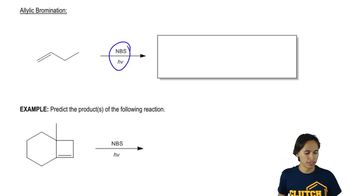
Mechanism of Allylic Bromination.

Reactivity of C-H Bonds

The reactivity of C-H bonds in alkanes varies based on the degree of substitution of the carbon atom to which the hydrogen is attached. Primary (1°) C-H bonds are less reactive than secondary (2°) C-H bonds due to the stability of the resulting radicals; 2° radicals are more stable than 1° radicals, leading to a higher likelihood of bromination at 2° sites.
Video consigliato:
Percorso guidato
3:15
Disulfide Bonds Example 2

Product Ratio and Relative Reactivity

The ratio of products formed during bromination reflects the relative reactivity of the different C-H bonds. By analyzing the product distribution, one can deduce the relative reactivity of 1° versus 2° C-H bonds. A higher proportion of products from 2° bromination compared to 1° indicates that 2° C-H bonds are more reactive under the given conditions.
Video consigliato:
04:32
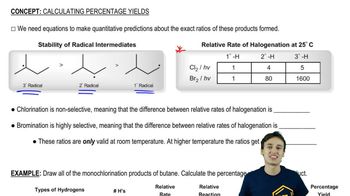
Explaining relative rates of halogenation.
Pratica correlata
Domanda del libro di testo

The radical fluorination of 2-methyl propane resulted in a 14:86 ratio of products.

(a) On the basis of this ratio, calculate the relative reactivity of 1° and 3° C―H bonds in the radical fluorination.

1167
views

Domanda del libro di testo

The following are all substitution reactions, two of which we study in later chapters. With no knowledge of mechanism, what would you expect the ratio of products to be for each reaction, based on a random statistical distribution?

(b) Replacing a hydrogen (H) with bromine (Br):

1444
views
Domanda del libro di testo

Through the course of this chapter, we have discussed only alkane chlorination and bromination, yet there are two other halogens we have not discussed.

(b) Is radical iodination a favorable reaction? Do you expect it to be selective? Show your calculations.

957
views
Domanda del libro di testo

The following are all substitution reactions, two of which we study in later chapters. With no knowledge of mechanism, what would you expect the ratio of products to be for each reaction, based on a random statistical distribution?

(a) Replacing a hydrogen (H) with deuterium (D):

693
views
Domanda del libro di testo

The radical fluorination of 2-methyl propane resulted in a 14:86 ratio of products.

(b) From the relative reactivity, calculate the difference in energy between the transition states of the first propagation steps leading to a 1° and 3° radical.

1068
views
Domanda del libro di testo

The following are all substitution reactions, two of which we study in later chapters. With no knowledge of mechanism, what would you expect the ratio of products to be for each reaction, based on a random statistical distribution?

(a) Replacing a hydrogen (H) with chlorine (Cl):

874
views