Ch. 5 - Chemical Reaction Analysis: Thermodynamics and Kinetics
Mullins - Organic Chemistry: A Learner Centered Approach 1st Edition
Mullins1st EditionOrganic Chemistry: A Learner Centered ApproachISBN: 9780137566471Non è quello che usi tu?Cambia libro di testo
Capitolo 4, Problema 60

Keto–enol tautomerism is a reaction we discuss in detail in Chapter 19. Estimate the equilibrium constant of this reaction (BDE for C―C π bond = 65 kcal/mol ; for C―O π bond = 85 kcal/mol).
Keto-enol tautomerism reaction showing the equilibrium between a carbonyl compound and its enol form.

Guida verificata passo dopo passo
1
Understand the concept of keto-enol tautomerism: This is a chemical equilibrium between a ketone (or aldehyde) and its enol form. The equilibrium constant depends on the relative stability of the keto and enol forms, which can be estimated using bond dissociation energies (BDEs).
Identify the relevant bond dissociation energies (BDEs): The problem provides the BDE for the C=C π bond (65 kcal/mol) and the C=O π bond (85 kcal/mol). These values will help us compare the stability of the keto and enol forms.
Calculate the energy difference between the keto and enol forms: The keto form has a C=O π bond, while the enol form has a C=C π bond. The energy difference can be calculated as ΔE = BDE(C=O) - BDE(C=C). Use MathML to represent this calculation: ΔE=BDE(C=O)-BDE(C=C)
Relate the energy difference to the equilibrium constant: The equilibrium constant (K_eq) can be estimated using the relationship ΔG = -RT ln(K_eq), where ΔG is the Gibbs free energy change (approximately equal to ΔE in this case). Rearrange to solve for K_eq: Keq=e-ΔE/RT
Substitute values into the equation: Use the calculated ΔE, the gas constant R (approximately 1.987 cal/(mol·K)), and the temperature T (assume room temperature, 298 K) to estimate K_eq. Ensure units are consistent when performing the calculation.

Risposta video verificata per un problema simile:

Questa soluzione video è stata consigliata dai nostri tutor come utile per risolvere questo problema.
Durata del video:
8m

Concetti chiave

Ecco i concetti essenziali che devi comprendere per rispondere correttamente alla domanda.

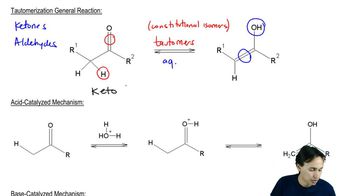
Keto-Enol Tautomerism

Keto-enol tautomerism is a chemical equilibrium between a keto form (a carbonyl compound) and its corresponding enol form (an alcohol with a double bond). This process involves the migration of a hydrogen atom and the shift of a double bond, which can significantly influence the reactivity and stability of organic compounds. Understanding this equilibrium is crucial for predicting the behavior of compounds in various chemical reactions.
Video consigliato:
05:11
Tautomerization Mechanisms

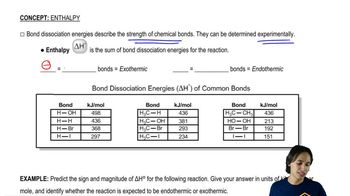
Bond Dissociation Energy (BDE)

Bond dissociation energy (BDE) is the energy required to break a specific bond in a molecule, resulting in the formation of free radicals. In the context of keto-enol tautomerism, the BDE values for the C-C π bond and the C-O π bond are essential for estimating the stability of the keto and enol forms. Higher BDE values indicate stronger bonds, which can affect the position of the equilibrium between the two tautomers.
Video consigliato:
04:09
How to calculate enthalpy using bond dissociation energies.

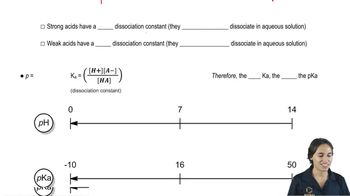
Equilibrium Constant (K)

The equilibrium constant (K) quantifies the ratio of the concentrations of products to reactants at equilibrium for a reversible reaction. In the case of keto-enol tautomerism, K can be calculated using the BDE values, reflecting the relative stability of the keto and enol forms. A larger K value indicates a greater concentration of products (usually the more stable form), while a smaller K suggests that the reactants are favored.
Video consigliato:
02:19
The relationship between equilibrium constant and pKa.