Domanda del libro di testo
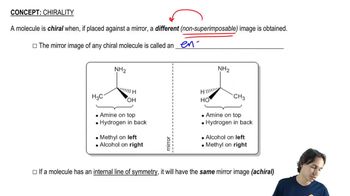
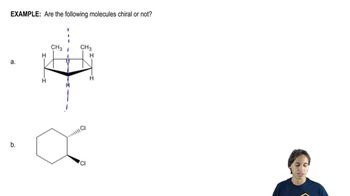
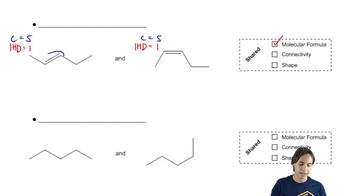
Identify the following molecules as chiral or achiral. If chiral, draw the nonsuperimposable mirror image and verify its nonsuperimposability.
(c)
1431
views

 Mullins 1st EditionCh. 6 - Stereoisomerism: Arrangement of Atoms in SpaceProblema 13

 Guida verificata passo dopo passo

 05:10

 00:25
 01:58
Identify the following molecules as chiral or achiral. If chiral, draw the nonsuperimposable mirror image and verify its nonsuperimposability.
(c)
Identify the following molecules as chiral or achiral. If chiral, draw the nonsuperimposable mirror image and verify its nonsuperimposability.
(e)
Draw the mirror image of the following molecule. Then, using the mirror image generated, switch the spatial orientation at the asymmetric center. Is the final structure the enantiomer of the original? If not, what is it?
Identify the following molecules as chiral or achiral. If chiral, draw the nonsuperimposable mirror image and verify its nonsuperimposability.
(f)
For each of the following chiral molecules, obtain the enantiomer (i) by drawing the nonsuperimposable mirror image and (ii) by switching the spatial orientation at each asymmetric center. Confirm (possibly using models) that the structures you drew for (i) and (ii) are the same.
(b)
For each of the following chiral molecules, obtain the enantiomer (i) by drawing the nonsuperimposable mirror image and (ii) by switching the spatial orientation at each asymmetric center. Confirm (possibly using models) that the structures you drew for (i) and (ii) are the same.
(d)