Ch. 6 - Stereoisomerism: Arrangement of Atoms in Space
Mullins - Organic Chemistry: A Learner Centered Approach 1st Edition
Mullins1st EditionOrganic Chemistry: A Learner Centered ApproachISBN: 9780137566471Non è quello che usi tu?Cambia libro di testo
Capitolo 5, Problema 18c

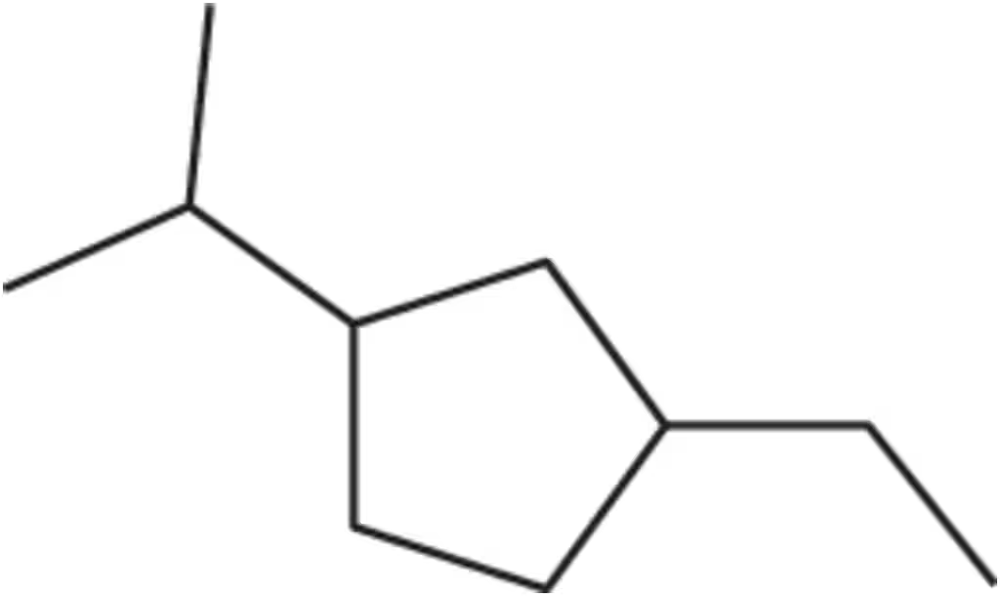
For the compound 1-ethyl-3-isopropylcyclopentane
Structural representation of 1-ethyl-3-isopropylcyclopentane showing cis and trans isomers.
(c) What is the stereochemical relationship between trans isomers?

Guida verificata passo dopo passo
1
Identify the structure of 1-ethyl-3-isopropylcyclopentane. The compound consists of a cyclopentane ring with an ethyl group attached at position 1 and an isopropyl group attached at position 3.
Understand the concept of trans isomers. In cycloalkanes, trans isomers occur when substituents are on opposite sides of the ring plane. For 1-ethyl-3-isopropylcyclopentane, the ethyl and isopropyl groups can be positioned either on the same side (cis) or opposite sides (trans) of the cyclopentane ring.
Analyze the stereochemical relationship between trans isomers. Trans isomers are stereoisomers, meaning they have the same connectivity of atoms but differ in the spatial arrangement of substituents. Specifically, trans isomers are diastereomers of the cis isomer.
Determine the specific stereochemical relationship between the two trans isomers. If there are two distinct trans configurations (e.g., differing in the orientation of substituents), they would also be diastereomers of each other. Diastereomers are non-superimposable and not mirror images.
Conclude that the stereochemical relationship between trans isomers of 1-ethyl-3-isopropylcyclopentane is that they are diastereomers, differing in the spatial arrangement of substituents on the cyclopentane ring.

Risposta video verificata per un problema simile:

Questa soluzione video è stata consigliata dai nostri tutor come utile per risolvere questo problema.

Concetti chiave

Ecco i concetti essenziali che devi comprendere per rispondere correttamente alla domanda.

Stereochemistry

Stereochemistry is the study of the spatial arrangement of atoms in molecules and how this affects their chemical properties and reactions. It includes concepts such as chirality, geometric isomerism, and conformational isomerism. Understanding stereochemistry is crucial for analyzing isomers, particularly in organic compounds where the arrangement of substituents can lead to different physical and chemical behaviors.
Video consigliato:
Percorso guidato
1:38
Polymer Stereochemistry Concept 1

Trans Isomers

Trans isomers are a type of geometric isomer where substituents are located on opposite sides of a double bond or a ring structure. This arrangement can significantly influence the physical properties of the compound, such as boiling point and solubility. In the context of cycloalkanes, trans isomers often exhibit more stability compared to their cis counterparts due to reduced steric strain.
Video consigliato:
01:10
What is a constitutional isomer?

Stereochemical Relationships

Stereochemical relationships refer to the spatial orientation of atoms or groups within a molecule and how these orientations relate to one another in different isomers. This includes concepts like enantiomers, diastereomers, and meso compounds. Understanding these relationships is essential for determining the reactivity and interaction of compounds, especially in biological systems where specific orientations can lead to different biological activities.
Video consigliato:
02:56
Isomeric Relationships