
Ch. 6 - Stereoisomerism: Arrangement of Atoms in Space
Mullins - Organic Chemistry: A Learner Centered Approach 1st Edition
Mullins1st EditionOrganic Chemistry: A Learner Centered ApproachISBN: 9780137566471Non è quello che usi tu?Cambia libro di testo
Capitolo 5, Problema 40c

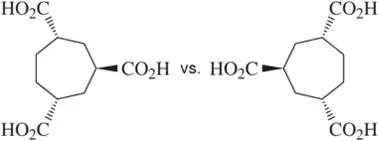
(i) Which of the following pairs of compounds would you expect to have different physical properties?
(ii) What is the relationship between each of the pairs?
(iii) Assign the absolute configuration of each stereocenter to confirm your answer.
(c)

Guida verificata passo dopo passo
1
Step 1: Analyze the given pairs of compounds and determine if they are stereoisomers, constitutional isomers, or identical compounds. Different physical properties are typically observed in stereoisomers (e.g., enantiomers and diastereomers) and constitutional isomers, but not in identical compounds.
Step 2: For each pair, identify the stereocenters (chiral centers) in the molecules. A stereocenter is an atom, typically carbon, bonded to four different groups.
Step 3: Assign the absolute configuration (R or S) to each stereocenter using the Cahn-Ingold-Prelog priority rules. These rules involve ranking substituents based on atomic number and determining the spatial arrangement of groups around the stereocenter.
Step 4: Compare the absolute configurations of the stereocenters in each pair of compounds. If the configurations differ, the compounds are stereoisomers (e.g., enantiomers or diastereomers). If the configurations are identical, the compounds may be identical.
Step 5: Based on the analysis, confirm whether the pairs of compounds have different physical properties and describe their relationship (e.g., enantiomers, diastereomers, constitutional isomers, or identical compounds).

Risposta video verificata per un problema simile:

Questa soluzione video è stata consigliata dai nostri tutor come utile per risolvere questo problema.
Durata del video:
8m

Concetti chiave

Ecco i concetti essenziali che devi comprendere per rispondere correttamente alla domanda.

Stereochemistry

Stereochemistry is the study of the spatial arrangement of atoms in molecules and how this affects their physical and chemical properties. It is crucial for understanding isomers, particularly stereoisomers, which have the same molecular formula but differ in the orientation of their atoms in space. This concept is essential for predicting differences in boiling points, melting points, and reactivity between compounds.
Video consigliato:
Percorso guidato
1:38
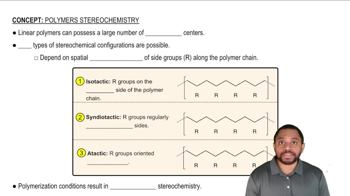
Polymer Stereochemistry Concept 1

Chirality

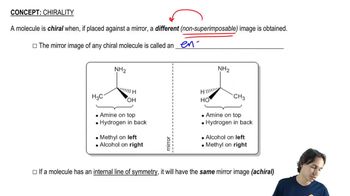
Chirality refers to the property of a molecule that makes it non-superimposable on its mirror image, much like left and right hands. Chiral molecules typically contain one or more stereocenters, which are carbon atoms bonded to four different substituents. The presence of chirality in a compound can lead to different physical properties and biological activities, making it a key factor in the analysis of compound pairs.
Video consigliato:
05:10
What is chirality?

Absolute Configuration

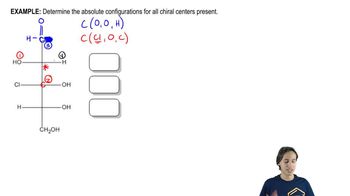
Absolute configuration describes the exact spatial arrangement of atoms around a stereocenter, designated using the R/S nomenclature system. This system assigns priorities to the substituents based on atomic number and orientation, allowing chemists to specify the 3D structure of chiral centers. Understanding absolute configuration is vital for confirming the identity of stereoisomers and predicting their distinct physical properties.
Video consigliato:
05:25
Determining Absolute Configurations