Ch. 6 - Stereoisomerism: Arrangement of Atoms in Space
Mullins - Organic Chemistry: A Learner Centered Approach 1st Edition
Mullins1st EditionOrganic Chemistry: A Learner Centered ApproachISBN: 9780137566471Non è quello che usi tu?Cambia libro di testo
Capitolo 5, Problema 8d

Identify all planes of symmetry in the following molecules/conformations, if any.
(d)

Guida verificata passo dopo passo
1
Step 1: Analyze the molecular structure provided. The molecule is a substituted cyclohexane in a chair conformation with a CH₃ group and a Br atom attached to the ring. The remaining substituents are hydrogen atoms.
Step 2: Recall the concept of a plane of symmetry. A plane of symmetry divides a molecule into two mirror-image halves. For cyclohexane in the chair conformation, symmetry depends on the arrangement of substituents.
Step 3: Examine the positions of the substituents. The CH₃ group is in an axial position, and the Br atom is in an equatorial position. The hydrogen atoms occupy the remaining axial and equatorial positions.
Step 4: Determine if a plane of symmetry exists. A plane of symmetry would require the substituents on one side of the molecule to mirror those on the opposite side. In this case, the CH₃ and Br groups disrupt symmetry, as they are different and positioned asymmetrically.
Step 5: Conclude that the molecule does not have a plane of symmetry due to the asymmetrical arrangement of the CH₃ and Br substituents in the chair conformation.

Risposta video verificata per un problema simile:

Questa soluzione video è stata consigliata dai nostri tutor come utile per risolvere questo problema.

Concetti chiave

Ecco i concetti essenziali che devi comprendere per rispondere correttamente alla domanda.

Planes of Symmetry

A plane of symmetry is an imaginary plane that divides a molecule into two mirror-image halves. Identifying these planes is crucial for determining the symmetry of a molecule, which can influence its physical and chemical properties. Molecules with planes of symmetry are often achiral, meaning they do not have non-superimposable mirror images.
Video consigliato:
02:58
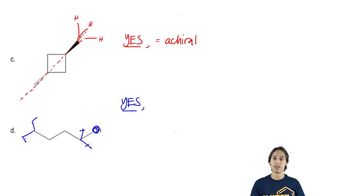
Determining Chirality with Plane of Symmetry

Chirality

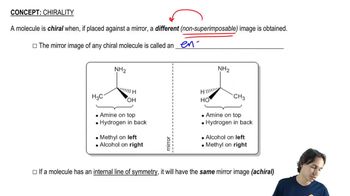
Chirality refers to the property of a molecule that makes it non-superimposable on its mirror image. A chiral molecule lacks a plane of symmetry and typically has at least one chiral center, often a carbon atom bonded to four different substituents. Understanding chirality is essential for predicting the behavior of molecules in biological systems and their interactions with polarized light.
Video consigliato:
05:10
What is chirality?

Molecular Conformations

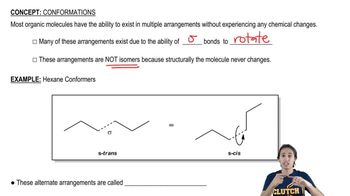
Molecular conformations are the different spatial arrangements of atoms in a molecule that result from rotation around single bonds. These conformations can affect the overall symmetry and chirality of the molecule. Analyzing conformations is important for understanding how molecular shape influences reactivity and interactions in organic chemistry.
Video consigliato:
03:29
Understanding what a conformer is.