

Ch. 6 - Stereoisomerism: Arrangement of Atoms in Space
Mullins - Organic Chemistry: A Learner Centered Approach 1st Edition
Mullins1st EditionOrganic Chemistry: A Learner Centered ApproachISBN: 9780137566471Non è quello che usi tu?Cambia libro di testo
Capitolo 5, Problema 60a

In Chapter 12, we introduce the SN2 reaction, a nucleophilic substitution reaction that proceeds with inversion. Confirm that inversion has occurred in each of the following examples by determining the absolute configuration of the chiral center in the reactants and products.
(a) Reaction diagram showing nucleophilic substitution with inversion at a chiral center, featuring reactants and products.

Guida verificata passo dopo passo
1
Step 1: Identify the chiral center in the reactant molecule. The carbon atom bonded to the bromine (Br), hydrogen (H), and two other groups is the chiral center.
Step 2: Assign priorities to the substituents around the chiral center based on the Cahn-Ingold-Prelog rules. Bromine (Br) has the highest priority due to its atomic number, followed by the isopropyl group, the methyl group, and finally hydrogen (H) with the lowest priority.
Step 3: Determine the absolute configuration of the chiral center in the reactant. Arrange the molecule so that the lowest priority group (H) is pointing away from you, then trace the path from the highest priority group to the lowest. If the path is clockwise, the configuration is R; if counterclockwise, it is S.
Step 4: Repeat the process for the product molecule. Assign priorities to the substituents around the chiral center in the product, where the cyanide group (N≡C) replaces bromine. Cyanide has a higher priority than bromine due to its atomic number.
Step 5: Compare the absolute configurations of the reactant and product. If the configuration has changed (e.g., from R to S or vice versa), inversion has occurred, confirming the SN2 reaction mechanism.

Risposta video verificata per un problema simile:

Questa soluzione video è stata consigliata dai nostri tutor come utile per risolvere questo problema.

Concetti chiave

Ecco i concetti essenziali che devi comprendere per rispondere correttamente alla domanda.

S_N 2 Reaction

The S_N 2 reaction is a type of nucleophilic substitution where a nucleophile attacks an electrophile, resulting in the simultaneous displacement of a leaving group. This reaction is characterized by a single concerted step, leading to the inversion of configuration at the chiral center. The rate of the reaction depends on the concentration of both the nucleophile and the substrate, making it bimolecular.
Video consigliato:
05:09
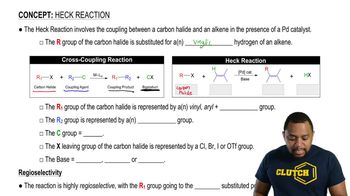
Heck Reaction

Inversion of Configuration

Inversion of configuration refers to the change in the spatial arrangement of atoms around a chiral center during a reaction. In S_N 2 reactions, the nucleophile approaches the electrophile from the opposite side of the leaving group, resulting in a switch of the configuration from R to S or vice versa. This is crucial for determining the stereochemical outcome of the reaction.
Video consigliato:
02:14
The Electron Configuration

Absolute Configuration

Absolute configuration describes the specific three-dimensional arrangement of atoms around a chiral center, designated as either R (rectus) or S (sinister) based on the Cahn-Ingold-Prelog priority rules. To confirm inversion in S_N 2 reactions, one must compare the absolute configurations of the reactants and products. This comparison helps in understanding how the stereochemistry is altered during the reaction.
Video consigliato:
05:25
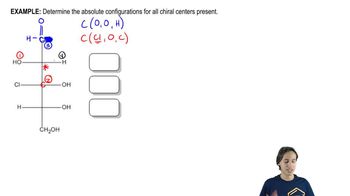
Determining Absolute Configurations
Pratica correlata
Domanda del libro di testo

A chemist working on the synthesis of (+)-pilocarpine, an alkaloid used in the treatment of dry mouth and glaucoma, produced a mixture of enantiomers that gave a specific rotation [α]D = +97°. Based on the specific rotation of the pure enantiomer, calculate the ratio of (+)- to (-)-pilocarpine produced by the chemist.

1003
views
Domanda del libro di testo

When the following substituted biphenyl was synthesized, it was found to have a specific rotation [α] of -23° at 25°C . When the specific rotation was measured at 100°C the compound had a specific rotation of 0° . Upon cooling back to 25°C the specific rotation was measured again, resulting in [α] = 0°. Explain these results.

1073
views
Domanda del libro di testo

In Chapter 13, we explain how to convert secondary alcohols into ketones using a mild oxidation reaction. When the following enantiomerically pure and optically active secondary alcohol is submitted to these reaction conditions, the product is optically inactive. Explain this observation.

1141
views
Domanda del libro di testo

A compound with two chiral centers that is meso will always have opposite absolute configurations at the two chiral centers. That is, a meso compound will never be (R,R) or (S,S); instead, it will be (R,S). Explain why this must be true.

1575
views
Domanda del libro di testo

In contrast to Assessment 6.63, the following compounds should be easily separable using standard methods. Why?

1050
views
Domanda del libro di testo

A chemist prepared a racemic mixture of the enantiomeric sulfonic acids shown here. Suggest two ways that these might be separated.

921
views