Ch. 6 - Stereoisomerism: Arrangement of Atoms in Space
Mullins - Organic Chemistry: A Learner Centered Approach 1st Edition
Mullins1st EditionOrganic Chemistry: A Learner Centered ApproachISBN: 9780137566471Non è quello che usi tu?Cambia libro di testo
Capitolo 5, Problema 1

Show all possible constitutional isomers of C5H12O. Label them as functional, positional, or chain isomers.

Guida verificata passo dopo passo
1
Step 1: Understand the molecular formula C₅H₁₂O. This indicates a compound with 5 carbon atoms, 12 hydrogen atoms, and 1 oxygen atom. The presence of oxygen suggests the possibility of functional groups such as alcohols (R-OH) or ethers (R-O-R').
Step 2: Begin by drawing all possible alcohol isomers (R-OH). Alcohols have the hydroxyl (-OH) group attached to different carbon atoms. Consider variations in the carbon chain (straight chain vs. branched chain) and the position of the hydroxyl group to generate positional and chain isomers.
Step 3: Next, draw all possible ether isomers (R-O-R'). Ethers have an oxygen atom bonded to two alkyl groups. Explore different combinations of straight and branched chains for the alkyl groups to generate chain isomers.
Step 4: Label each isomer as functional, positional, or chain isomers. Functional isomers differ in the functional group (e.g., alcohol vs. ether). Positional isomers have the same functional group but differ in the position of the group on the carbon chain. Chain isomers differ in the arrangement of the carbon skeleton (e.g., straight vs. branched chains).
Step 5: Verify that all possible constitutional isomers have been considered by ensuring no duplicate structures and that all variations of chain, position, and functional groups are accounted for. Double-check the molecular formula (C₅H₁₂O) for each structure to confirm correctness.

Risposta video verificata per un problema simile:

Questa soluzione video è stata consigliata dai nostri tutor come utile per risolvere questo problema.
Durata del video:
5m

Concetti chiave

Ecco i concetti essenziali che devi comprendere per rispondere correttamente alla domanda.

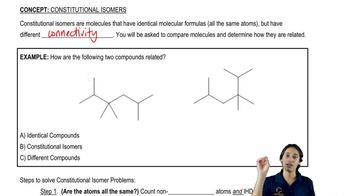
Constitutional Isomers

Constitutional isomers are compounds that have the same molecular formula but differ in the connectivity of their atoms. This means that the arrangement of atoms in the molecule varies, leading to different structural forms. For example, C₅H₁₂O can have various isomers based on how the carbon, hydrogen, and oxygen atoms are connected.
Video consigliato:
01:10
What is a constitutional isomer?

Functional Isomers

Functional isomers are a type of constitutional isomer where the isomers differ in the functional group present in the molecule. For instance, in C₅H₁₂O, one isomer could be an alcohol (like pentanol) while another could be an ether (like dimethyl ether), showcasing different chemical properties and reactivities due to the distinct functional groups.
Video consigliato:
01:10
What is a constitutional isomer?

Positional and Chain Isomers

Positional isomers occur when the functional group is located at different positions on the carbon chain, while chain isomers arise from variations in the carbon skeleton itself, such as branching. In the case of C₅H₁₂O, chain isomers could include straight-chain and branched forms of pentanol, whereas positional isomers would involve the functional group being placed at different carbon atoms in the chain.
Video consigliato:
01:10
What is a constitutional isomer?