
For each of the products you predicted in Assessment 8.39, provide an arrow-pushing mechanism which rationalizes the formation of each product. Make sure your mechanism accounts for all products formed, including stereoisomers and regioisomers, where applicable.
Ch. 8 - Alkenes 1: Properties and Electrophilic Additions

Mullins1st EditionOrganic Chemistry: A Learner Centered ApproachISBN: 9780137566471Non è quello che usi tu?Cambia libro di testo
Tutti i libri di testo
Mullins 1st Edition
Ch. 8 - Alkenes 1: Properties and Electrophilic Additions
Problema 39a
Mullins 1st Edition
Ch. 8 - Alkenes 1: Properties and Electrophilic Additions
Problema 39aCapitolo 7, Problema 39a
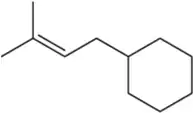
Provide the expected product for the reaction of each of the following alkenes with H2SO4 and H2O.
(a) 
Guida verificata passo dopo passo1
Step 1: Understand the reaction mechanism. The reaction involves the addition of water (H₂O) in the presence of sulfuric acid (H₂SO₄) to an alkene. This is an example of an acid-catalyzed hydration reaction, which follows Markovnikov's rule.
Step 2: Identify the alkene structure. Analyze the given alkene to determine the position of the double bond and the substituents attached to the carbon atoms involved in the double bond.
Step 3: Protonation of the alkene. The first step in the mechanism is the protonation of the double bond by H⁺ from H₂SO₄, forming a carbocation intermediate. Use Markovnikov's rule to predict which carbon will bear the positive charge (the more substituted carbon is favored).
Step 4: Nucleophilic attack by water. The carbocation intermediate is attacked by a water molecule, leading to the formation of an oxonium ion (R-CH₂-OH₂⁺).
Step 5: Deprotonation. The oxonium ion loses a proton (H⁺), resulting in the formation of the final alcohol product. Ensure the product aligns with Markovnikov's rule, where the hydroxyl group (-OH) is added to the more substituted carbon of the original double bond.

Risposta video verificata per un problema simile:
Questa soluzione video è stata consigliata dai nostri tutor come utile per risolvere questo problema.
Durata del video:
3mConcetti chiave
Ecco i concetti essenziali che devi comprendere per rispondere correttamente alla domanda.
Electrophilic Addition
Electrophilic addition is a fundamental reaction mechanism in organic chemistry where an electrophile reacts with a nucleophile, typically involving alkenes. In the presence of strong acids like H₂SO₄, the double bond of the alkene acts as a nucleophile, attacking the electrophilic hydrogen, leading to the formation of a carbocation intermediate. This step is crucial for understanding how alkenes react with acids and water.
Video consigliato:
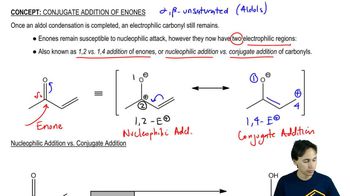
1,2 vs 1,4 Addition
Carbocation Stability
Carbocation stability is a key concept in predicting the outcome of reactions involving alkenes. Carbocations are positively charged species that can vary in stability based on their structure; tertiary carbocations are more stable than secondary or primary ones due to hyperconjugation and inductive effects. Understanding the stability of carbocations helps in determining the major product formed during the reaction with H₂SO₄ and H₂O.
Video consigliato:
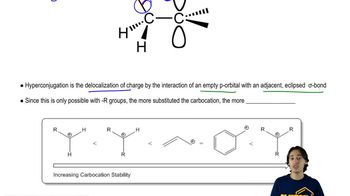
Determining Carbocation Stability
Hydration Reaction
The hydration reaction involves the addition of water (H₂O) to an alkene, resulting in the formation of an alcohol. In the context of the reaction with H₂SO₄, the acid protonates the alkene to form a carbocation, which then reacts with water to yield the alcohol product. This process is essential for converting alkenes into alcohols and is a common transformation in organic synthesis.
Video consigliato:
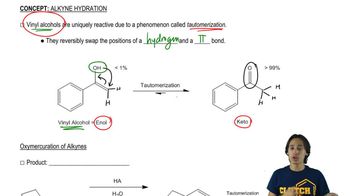
Alkyne Hydration
Pratica correlata
Domanda del libro di testo
1148
views
Domanda del libro di testo
Radical addition to alkenes is not effective for the synthesis of iodo- and chloroalkanes. Using your knowledge of the mechanism of this reaction, along with bond dissociation energies, explain why the radical additions of HI and HCl are not effective. (Assume ∆H = 65 kcal/ mol for the C–C π bond.)
1002
views
Domanda del libro di testo
Provide the expected product for the reaction of each of the following alkenes with H2SO4 and H2O.
(d)
903
views
Domanda del libro di testo
Provide the expected product for the reaction of each of the following alkenes with H2SO4 and H2O.
(b)
742
views
Domanda del libro di testo
Which reagent system (HBr or HBr, H2O2) would you use to carry out the following transformations?
(c)
743
views
Domanda del libro di testo
Which reagent system (HBr or HBr, H2O2) would you use to carry out the following transformations?
(b)
1035
views