Ch. 8 - Alkenes 1: Properties and Electrophilic Additions
Mullins - Organic Chemistry: A Learner Centered Approach 1st Edition
Mullins1st EditionOrganic Chemistry: A Learner Centered ApproachISBN: 9780137566471Non è quello che usi tu?Cambia libro di testo
Capitolo 7, Problema 35b

Provide the expected product for the reaction of each of the following alkenes with (i) HBr and (ii) HBr, H2O2
(b) Chemical structure of 3-methyl-1-pentene, an alkene with a double bond between the first and second carbon atoms.

Guida verificata passo dopo passo
1
Identify the structure of the alkene involved in the reaction. Alkenes are hydrocarbons with a carbon-carbon double bond, which is the site of reactivity in these reactions.
For the reaction with HBr alone, apply Markovnikov's rule. This rule states that in the addition of HX (where X is a halogen) to an alkene, the hydrogen atom will attach to the carbon with the greater number of hydrogen atoms already attached, and the halogen will attach to the carbon with fewer hydrogen atoms. This results in the formation of the more stable carbocation intermediate.
Draw the intermediate carbocation formed after the initial addition of HBr to the alkene. Consider the stability of the carbocation, as tertiary carbocations are more stable than secondary, which are more stable than primary.
For the reaction with HBr and H₂O₂, apply anti-Markovnikov's rule. In the presence of peroxides, the addition of HBr to an alkene proceeds via a radical mechanism, where the bromine atom attaches to the carbon with more hydrogen atoms, opposite to Markovnikov's rule.
Draw the expected product for each reaction, considering the regioselectivity (Markovnikov vs. anti-Markovnikov) and the mechanism (ionic vs. radical) involved in each case.

Risposta video verificata per un problema simile:

Questa soluzione video è stata consigliata dai nostri tutor come utile per risolvere questo problema.
Durata del video:
3m

Concetti chiave

Ecco i concetti essenziali che devi comprendere per rispondere correttamente alla domanda.

Markovnikov's Rule

Markovnikov's Rule states that in the addition of HX (where X is a halogen) to an alkene, the hydrogen atom will attach to the carbon with more hydrogen atoms, and the halogen will attach to the carbon with fewer hydrogen atoms. This rule helps predict the major product in the absence of peroxides.
Video consigliato:
03:54
The 18 and 16 Electron Rule

Anti-Markovnikov Addition

Anti-Markovnikov addition occurs when HBr is added to an alkene in the presence of peroxides (H₂O₂). The reaction proceeds via a radical mechanism, resulting in the bromine atom attaching to the less substituted carbon, opposite to Markovnikov's Rule, due to the influence of the radical initiator.
Video consigliato:
02:43
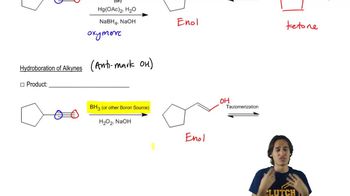
Anti-Markovnikov addition of alcohols to terminal alkynes yields aldehydes

Radical Mechanism

A radical mechanism involves the formation of free radicals, which are highly reactive species with unpaired electrons. In the presence of peroxides, the addition of HBr to alkenes follows a radical pathway, leading to anti-Markovnikov products. Understanding this mechanism is crucial for predicting product formation in peroxide-mediated reactions.
Video consigliato:
03:28
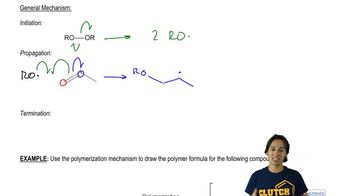
The mechanism of Radical Polymerization.