Ch. 8 - Alkenes 1: Properties and Electrophilic Additions
Mullins - Organic Chemistry: A Learner Centered Approach 1st Edition
Mullins1st EditionOrganic Chemistry: A Learner Centered ApproachISBN: 9780137566471Non è quello che usi tu?Cambia libro di testo
Capitolo 7, Problema 44

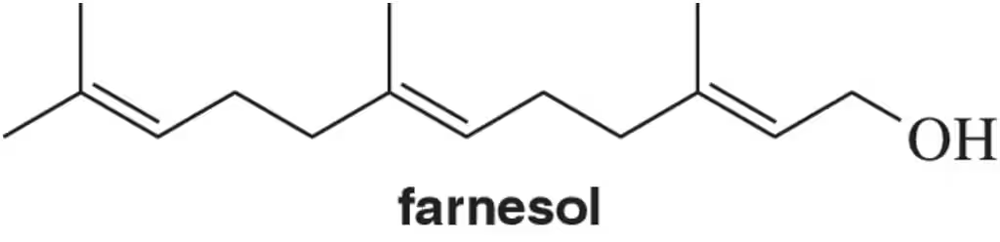
Suggest a mechanism for the synthesis of farnesol beginning with IPP and DPP.
Chemical structure of farnesol with a hydroxyl group, labeled "farnesol" at the bottom.

Guida verificata passo dopo passo
1
Step 1: Identify the starting materials. IPP (isopentenyl pyrophosphate) and DPP (dimethylallyl pyrophosphate) are both five-carbon isoprenoid units. Farnesol is a 15-carbon compound, so the synthesis involves combining three isoprenoid units.
Step 2: Perform the first coupling reaction. DPP acts as the electrophile, and IPP acts as the nucleophile. The pyrophosphate group of DPP is displaced, forming a 10-carbon intermediate called geranyl pyrophosphate (GPP). This reaction is catalyzed by geranyl pyrophosphate synthase.
Step 3: Perform the second coupling reaction. GPP now acts as the electrophile, and another molecule of IPP acts as the nucleophile. The pyrophosphate group of GPP is displaced, forming a 15-carbon intermediate called farnesyl pyrophosphate (FPP). This reaction is catalyzed by farnesyl pyrophosphate synthase.
Step 4: Hydrolyze the pyrophosphate group of FPP. The pyrophosphate group is removed, yielding farnesol. This step is typically catalyzed by a phosphatase enzyme.
Step 5: Verify the structure of farnesol. Farnesol contains three isoprenoid units, two double bonds in the trans configuration, and a terminal hydroxyl group. Ensure the stereochemistry and functional groups match the target molecule.

Risposta video verificata per un problema simile:

Questa soluzione video è stata consigliata dai nostri tutor come utile per risolvere questo problema.
Durata del video:
12m

Concetti chiave

Ecco i concetti essenziali che devi comprendere per rispondere correttamente alla domanda.

Isoprenoid Biosynthesis

Isoprenoid biosynthesis is a fundamental pathway in organic chemistry that involves the formation of isoprene units, which are the building blocks of many natural products. In this context, isopentenyl pyrophosphate (IPP) and dimethylallyl pyrophosphate (DPP) are key intermediates that undergo condensation reactions to form larger isoprenoid compounds, such as farnesol.

Condensation Reactions

Condensation reactions are chemical processes where two molecules combine to form a larger molecule, releasing a small molecule, often water. In the synthesis of farnesol, IPP and DPP undergo a series of condensation reactions, where they join together to create longer carbon chains, ultimately leading to the formation of farnesol through sequential addition of isoprene units.
Video consigliato:
05:53
Condensation Reactions

Farnesol Structure and Function

Farnesol is a sesquiterpene alcohol with a specific structure that includes three isoprene units. Understanding its structure is crucial for predicting its reactivity and potential applications, such as in fragrance and flavor industries. The synthesis of farnesol from IPP and DPP highlights the importance of structural features in organic compounds and their biological significance.
Video consigliato:
02:36
Identifying Functional Groups