Ch. 9 - Alkenes 2: Oxidation and Reduction
Mullins - Organic Chemistry: A Learner Centered Approach 1st Edition
Mullins1st EditionOrganic Chemistry: A Learner Centered ApproachISBN: 9780137566471Non è quello che usi tu?Cambia libro di testo
Capitolo 8, Problema 28

Despite it being equally favorable, opening of the epoxide does not happen in the absence of an acid catalyst. How does acid make the reaction faster? Demonstrate this concept by directly comparing the reaction coordinate diagram for both situations A and B.

Guida verificata passo dopo passo
1
In Situation A (without acid), the epoxide ring opens via a nucleophilic attack by water. However, the oxygen in the epoxide is not protonated, so the ring strain is not significantly reduced, and the reaction proceeds slowly due to the high activation energy required to break the epoxide bond.
In Situation B (with acid), the epoxide oxygen is first protonated by the acid, forming a positively charged oxonium ion. This protonation increases the electrophilicity of the epoxide carbon atoms, making them more susceptible to nucleophilic attack.
The protonation in Situation B also reduces the activation energy of the reaction by stabilizing the transition state. This is because the positive charge on the oxonium ion delocalizes, lowering the energy barrier for the ring-opening step.
The reaction coordinate diagram for Situation A would show a higher activation energy peak compared to Situation B. In Situation B, the protonation step creates an intermediate with lower energy, resulting in a smaller energy difference between the reactants and the transition state.
Overall, the acid catalyst in Situation B accelerates the reaction by both increasing the electrophilicity of the epoxide and lowering the activation energy, as demonstrated by the lower energy barrier in the reaction coordinate diagram.

Risposta video verificata per un problema simile:

Questa soluzione video è stata consigliata dai nostri tutor come utile per risolvere questo problema.
Durata del video:
10m

Concetti chiave

Ecco i concetti essenziali che devi comprendere per rispondere correttamente alla domanda.

Epoxide Reactivity

Epoxides are three-membered cyclic ethers that are highly strained, making them reactive towards nucleophiles. The strain in the epoxide ring creates a tendency for the ring to open, but this reaction can be significantly influenced by the presence of catalysts, particularly acids, which stabilize the transition state.
Video consigliato:
02:19
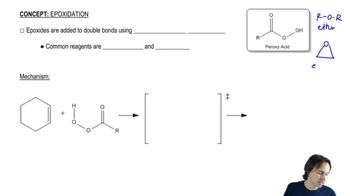
General properties of epoxidation.

Acid Catalysis

Acid catalysis involves the use of an acid to increase the rate of a chemical reaction. In the case of epoxide opening, the acid protonates the oxygen atom in the epoxide, increasing its electrophilicity. This makes the carbon atoms in the epoxide more susceptible to nucleophilic attack, thereby accelerating the reaction.
Video consigliato:
Percorso guidato
2:50
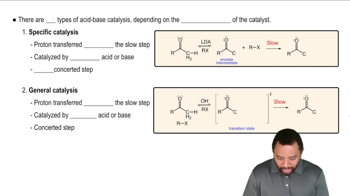
Acid-Base Catalysis Concept 3

Reaction Coordinate Diagram

A reaction coordinate diagram visually represents the energy changes during a chemical reaction. It illustrates the energy of reactants, products, and transition states. By comparing diagrams for acid-catalyzed and uncatalyzed reactions, one can observe how the presence of an acid lowers the activation energy barrier, facilitating a faster reaction.
Video consigliato:
05:02
Coordination Complexes