Ch. 9 - Alkenes 2: Oxidation and Reduction
Mullins - Organic Chemistry: A Learner Centered Approach 1st Edition
Mullins1st EditionOrganic Chemistry: A Learner Centered ApproachISBN: 9780137566471Non è quello che usi tu?Cambia libro di testo
Capitolo 8, Problema 55

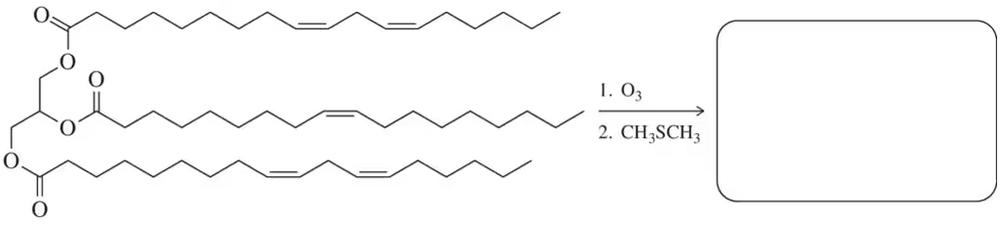
Predict the product of ozonolysis of the triglyceride shown.
Triglyceride structure with ozonolysis reaction steps, O3 and CH3SCH3, leading to product prediction.

Guida verificata passo dopo passo
1
Identify the double bonds in the triglyceride structure. These are the sites where ozonolysis will occur. In the image, each fatty acid chain contains one or more double bonds.
Understand the ozonolysis reaction: Ozonolysis involves the cleavage of double bonds using ozone (O₃), followed by a reductive workup, typically with a reducing agent like dimethyl sulfide (CH₃SCH₃). This process converts the double bonds into carbonyl groups.
For each double bond in the triglyceride, predict the formation of two carbonyl compounds. The double bond is cleaved, and each carbon atom of the double bond becomes part of a separate carbonyl group.
Consider the structure of the triglyceride: It consists of three fatty acid chains esterified to a glycerol backbone. Each fatty acid chain will undergo ozonolysis independently, resulting in multiple carbonyl compounds.
Compile the predicted products: After ozonolysis, each double bond in the fatty acid chains will yield aldehydes or ketones, depending on the position of the double bond within the chain. The glycerol backbone remains unchanged.

Risposta video verificata per un problema simile:

Questa soluzione video è stata consigliata dai nostri tutor come utile per risolvere questo problema.

Concetti chiave

Ecco i concetti essenziali che devi comprendere per rispondere correttamente alla domanda.

Ozonolysis

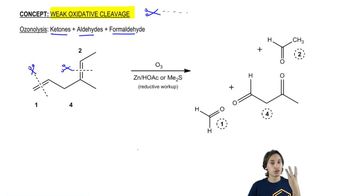
Ozonolysis is a reaction where ozone (O3) cleaves alkenes to form carbonyl compounds. In the presence of a reducing agent like dimethyl sulfide (CH3SCH3), the reaction yields aldehydes or ketones. This process is crucial for breaking down unsaturated fatty acid chains in triglycerides, as seen in the image.
Video consigliato:
06:30
General properties of ozonolysis.

Triglyceride Structure

Triglycerides consist of a glycerol backbone esterified with three fatty acid chains. These chains can be saturated or unsaturated, affecting their chemical reactivity. Understanding the structure helps predict how ozonolysis will cleave the unsaturated bonds, leading to specific products based on the fatty acid composition.
Video consigliato:
03:04
Drawing Resonance Structures

Fatty Acid Unsaturation

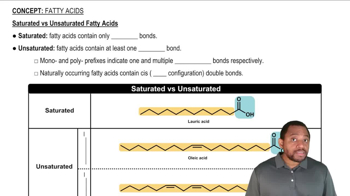
Unsaturated fatty acids contain one or more double bonds, which are reactive sites for ozonolysis. The presence of these double bonds in the triglyceride's fatty acid chains determines the cleavage points and the resulting carbonyl compounds. Identifying these unsaturated sites is essential for predicting the ozonolysis products.
Video consigliato:
Percorso guidato
1:54
Fatty Acids Concept 2
Pratica correlata
Domanda del libro di testo

Ozonolysis of an unknown alkene A gives the products shown. Predict the product that results from hydrogenation of alkene A. [There are multiple answers, but only show the one with the 6-membered ring.]

1016
views

Domanda del libro di testo

Bromination of a highly electron-rich alkene such as 2-methoxybut-2-ene has been shown to produce approximately equal mixtures of the trans- and cis-dibromide. Suggest an explanation for this observation.

1635
views
Domanda del libro di testo

In Chapter 19, we discuss the reaction of enols with bromine. This reaction produces α -bromoketones in good yields. Suggest a mechanism for this reaction and justify its deviation from the dibromide product you might have expected.

1958
views
Domanda del libro di testo

At the beginning of Chapter 9, we stated that after finishing Chapters 8 and 9, we would have the ability to make a large variety of functional groups using related reactions. Show the reagent(s) necessary to convert 1-isobutylcyclohexene into the following molecules.

(a)

1157
views
Domanda del libro di testo

In spite of being mechanistically similar to some of the reactions we saw in Chapter 8, rearrangement never occurred here in Chapter 9. Why doesn't rearrangement occur in the following bromination reaction despite the proximity of a more substituted carbon?

947
views
Domanda del libro di testo

Bromination of buta-1,3-diene with a single equivalent of Br2 can give either of two products. (a) Which of these products (A or B) would you predict to be more stable? Justify your answer.

1195
views