


Ch. 9 - Alkenes 2: Oxidation and Reduction
Mullins - Organic Chemistry: A Learner Centered Approach 1st Edition
Mullins1st EditionOrganic Chemistry: A Learner Centered ApproachISBN: 9780137566471Non è quello che usi tu?Cambia libro di testo
Capitolo 8, Problema 61b

Suggest mechanisms for the following reactions, which are similar to the mechanism we saw for lanosterol biosynthesis at the end of Chapter 8.
(b)

Guida verificata passo dopo passo
1
Step 1: Analyze the starting material and the product. The starting material is an epoxide-containing compound, and the product is a cyclic compound with a hydroxyl group and a bromine atom. This suggests that the reaction involves epoxide ring opening followed by cyclization and bromination.
Step 2: Protonation of the epoxide. The reaction begins with the protonation of the oxygen atom in the epoxide by HBr, making the epoxide more electrophilic and susceptible to nucleophilic attack.
Step 3: Nucleophilic attack and ring opening. The protonated epoxide undergoes nucleophilic attack by the alkene group present in the molecule. This leads to the opening of the epoxide ring and the formation of a carbocation intermediate.
Step 4: Cyclization via carbocation rearrangement. The carbocation intermediate undergoes intramolecular cyclization, forming a stable cyclic structure. This step is driven by the formation of a more stable carbocation and the release of ring strain.
Step 5: Bromination of the carbocation. The bromide ion (Br⁻) from HBr attacks the carbocation formed during cyclization, resulting in the addition of bromine to the molecule. This completes the reaction, yielding the final product with both hydroxyl and bromine groups.

Risposta video verificata per un problema simile:

Questa soluzione video è stata consigliata dai nostri tutor come utile per risolvere questo problema.
Durata del video:
3m

Concetti chiave

Ecco i concetti essenziali che devi comprendere per rispondere correttamente alla domanda.

Electrophilic Addition Reactions

Electrophilic addition reactions involve the addition of an electrophile to a nucleophile, typically across a double bond. In the context of the reaction shown, H-Br acts as the electrophile, where the hydrogen atom adds to one carbon of the double bond, while the bromine adds to the other. This mechanism is crucial for understanding how alkenes and alkynes react with halogens and acids.
Video consigliato:
05:39
Features of Addition Mechanisms.

Markovnikov's Rule

Markovnikov's Rule states that in the addition of HX to an alkene, the hydrogen atom will attach to the carbon with the greater number of hydrogen atoms already attached, while the halide (X) will attach to the carbon with fewer hydrogen atoms. This principle helps predict the major product of the reaction, as seen in the transformation of the starting material to the final product in the image.
Video consigliato:
03:54
The 18 and 16 Electron Rule

Biosynthesis of Steroids

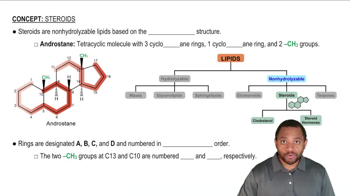
The biosynthesis of steroids, such as lanosterol, involves a series of enzymatic reactions that convert simpler organic molecules into complex steroid structures. Understanding the mechanisms of these transformations, including the role of intermediates and the stereochemistry involved, is essential for analyzing similar reactions, like the one depicted, which may involve similar enzymatic pathways or structural rearrangements.
Video consigliato:
Percorso guidato
1:27
Steroids Concept 1