Ch.11 - Reactions of Alcohols
Wade - Organic Chemistry 9th Edition
Wade9th EditionOrganic ChemistryISBN: 9780135213728Non è quello che usi tu?Cambia libro di testo
Capitolo 11, Problema 39e,f,g

Predict the major products of the following reactions, including stereochemistry where appropriate.
(e) cyclopentylmethanol + Na2Cr2O7/H2SO4
(f) cyclopentanol + HCl/ZnCl2
(g) n-butanol + HBr

Guida verificata passo dopo passo
1
Step 1: For reaction (e), cyclopentylmethanol + Na₂Cr₂O₇/H₂SO₄, recognize that this is an oxidation reaction. Sodium dichromate (Na₂Cr₂O₇) in acidic conditions (H₂SO₄) is a strong oxidizing agent. Primary alcohols like cyclopentylmethanol are oxidized to carboxylic acids. Write the structure of cyclopentylmethanol and identify the hydroxyl (-OH) group attached to the carbon atom.
Step 2: In reaction (e), replace the hydrogen atoms on the carbon attached to the hydroxyl group with oxygen atoms to form a carboxylic acid. The product will be cyclopentane carboxylic acid. Ensure to maintain the cyclopentane ring structure in the product.
Step 3: For reaction (f), cyclopentanol + HCl/ZnCl₂, recognize that this is a Lucas test reaction. ZnCl₂ acts as a Lewis acid catalyst, and HCl provides the chloride ion. Secondary alcohols like cyclopentanol undergo substitution reactions to form alkyl halides. Write the structure of cyclopentanol and identify the hydroxyl (-OH) group.
Step 4: In reaction (f), the hydroxyl group (-OH) is replaced by a chloride ion (Cl⁻) to form cyclopentyl chloride. This is an SN1 reaction, so consider the formation of a carbocation intermediate. Since cyclopentanol forms a stable secondary carbocation, the reaction proceeds efficiently.
Step 5: For reaction (g), n-butanol + HBr, recognize that this is a substitution reaction where the hydroxyl group (-OH) of the primary alcohol is replaced by a bromide ion (Br⁻). Write the structure of n-butanol and identify the hydroxyl group. The reaction proceeds via an SN2 mechanism because n-butanol is a primary alcohol. Replace the -OH group with Br to form 1-bromobutane as the product.

Risposta video verificata per un problema simile:

Questa soluzione video è stata consigliata dai nostri tutor come utile per risolvere questo problema.
Durata del video:
4m

Concetti chiave

Ecco i concetti essenziali che devi comprendere per rispondere correttamente alla domanda.

Oxidation and Reduction Reactions

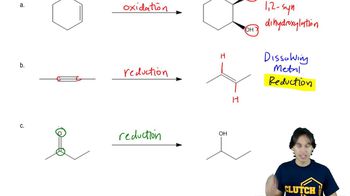
In organic chemistry, oxidation refers to the loss of electrons or an increase in oxidation state, often involving the addition of oxygen or the removal of hydrogen. In the context of cyclopentylmethanol reacting with Na2Cr2O7/H2SO4, this reaction leads to the oxidation of the alcohol to a ketone or carboxylic acid, depending on the conditions. Understanding the principles of oxidation is crucial for predicting the products of such reactions.
Video consigliato:
00:54
Distinguishing between Oxidation and Reduction

Acid-Catalyzed Reactions

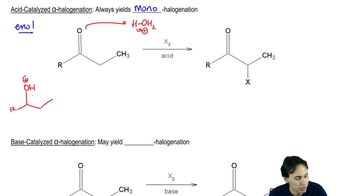
Acid-catalyzed reactions, such as the reaction of cyclopentanol with HCl/ZnCl2, involve the protonation of the alcohol, making it a better leaving group. This process facilitates the conversion of alcohols to alkyl halides through nucleophilic substitution. Recognizing the role of acids in enhancing reactivity is essential for predicting the major products and their stereochemistry in these reactions.
Video consigliato:
03:09
Acid Catalyzed

Nucleophilic Substitution Mechanisms

Nucleophilic substitution mechanisms, such as SN1 and SN2, describe how nucleophiles replace leaving groups in organic compounds. For example, in the reaction of n-butanol with HBr, the mechanism can vary based on the substrate and conditions, leading to different products. Understanding these mechanisms is vital for predicting the outcome of reactions involving alcohols and halogen acids.
Video consigliato:
01:47
Nucleophiles and Electrophiles can react in Substitution Reactions.