Ch.11 - Reactions of Alcohols
Wade - Organic Chemistry 9th Edition
Wade9th EditionOrganic ChemistryISBN: 9780135213728Non è quello che usi tu?Cambia libro di testo
Capitolo 11, Problema 55a

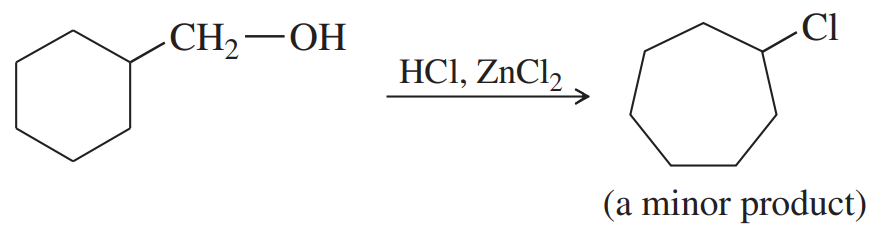
Propose mechanisms for the following reactions. In most cases, more products are formed than are shown here. You only need to explain the formation of the products shown, however.
(a) Chemical reaction showing conversion of a cyclohexanol to a chlorocyclohexane using HCl and ZnCl2, labeled as a minor product.

Guida verificata passo dopo passo
1
Step 1: Recognize the reaction conditions. The presence of HCl and ZnCl₂ indicates that this is a Lucas test reaction, which involves the conversion of alcohols to alkyl halides via an SN1 mechanism. ZnCl₂ acts as a Lewis acid, enhancing the reactivity of the alcohol.
Step 2: Protonation of the alcohol group. The hydroxyl group (-OH) on the cyclohexylmethanol is protonated by HCl, forming water as a leaving group. This step increases the electrophilicity of the carbon attached to the hydroxyl group.
Step 3: Formation of a carbocation intermediate. After the water molecule leaves, a carbocation is formed at the benzylic position (CH₂ group attached to the cyclohexane ring). This carbocation is relatively stable due to hyperconjugation and inductive effects from the cyclohexane ring.
Step 4: Rearrangement of the carbocation. A hydride shift occurs from the cyclohexane ring to the carbocation, resulting in a more stable secondary carbocation directly on the cyclohexane ring. This rearrangement explains the formation of the minor product.
Step 5: Nucleophilic attack by chloride ion. The chloride ion (Cl⁻) from HCl attacks the secondary carbocation, forming the final product, chlorocyclohexane. This product is labeled as the minor product because the primary product would involve substitution at the original benzylic position without rearrangement.

Risposta video verificata per un problema simile:

Questa soluzione video è stata consigliata dai nostri tutor come utile per risolvere questo problema.
Durata del video:
5m

Concetti chiave

Ecco i concetti essenziali che devi comprendere per rispondere correttamente alla domanda.

Reaction Mechanisms

A reaction mechanism is a step-by-step description of how a chemical reaction occurs at the molecular level. It outlines the sequence of elementary steps, including bond breaking and formation, that lead to the transformation of reactants into products. Understanding mechanisms is crucial for predicting the products of reactions and for explaining why certain pathways are favored over others.
Video consigliato:
02:16
Heck Reaction Mechanism

Types of Organic Reactions

Organic reactions can be classified into several types, including substitution, addition, elimination, and rearrangement reactions. Each type has distinct characteristics and mechanisms. Recognizing the type of reaction helps in predicting the behavior of reactants and the nature of the products formed, which is essential for proposing accurate mechanisms.
Video consigliato:
07:37
Properties and Types of Pericyclic Reactions

Stability of Intermediates

The stability of reaction intermediates, such as carbocations, carbanions, and free radicals, plays a significant role in determining the pathway of a reaction. More stable intermediates are generally formed preferentially, influencing the overall reaction mechanism and the products generated. Understanding the factors that affect stability, such as resonance and inductive effects, is vital for accurately proposing mechanisms.
Video consigliato:
04:31
Stability of Conjugated Intermediates
Pratica correlata
Domanda del libro di testo

Propose mechanisms for the following reactions. In most cases, more products are formed than are shown here. You only need to explain the formation of the products shown, however.

(b)

679
views

Domanda del libro di testo

Give the structures of the intermediates and products V through Z.

1667
views
1
rank
Domanda del libro di testo

Show how you would synthesize the following compounds. As starting materials, you may use any alcohols containing four or fewer carbon atoms, cyclohexanol, and any necessary solvents and inorganic reagents.

(a)

(b)

(c)

1583
views
Domanda del libro di testo

Propose mechanisms for the following reactions. In most cases, more products are formed than are shown here. You only need to explain the formation of the products shown, however.

(c)

588
views
Domanda del libro di testo

Under acid catalysis, tetrahydrofurfuryl alcohol reacts to give surprisingly good yields of dihydropyran. Propose a mechanism to explain this useful synthesis.

680
views
Domanda del libro di testo

Compound A is an optically active alcohol. Treatment with chromic acid converts A into a ketone, B. In a separate reaction, A is treated with PBr3, converting A into compound C. Compound C is purified, and then it is allowed to react with magnesium in ether to give a Grignard reagent, D. Compound B is added to the resulting solution of the Grignard reagent. After hydrolysis of the initial product (E), this solution is found to contain 3,4-dimethylhexan-3-ol. Propose structures for compounds A, B, C, D, and E.

1798
views