
Ch.11 - Reactions of Alcohols
Wade - Organic Chemistry 9th Edition
Wade9th EditionOrganic ChemistryISBN: 9780135213728Non è quello che usi tu?Cambia libro di testo
Capitolo 11, Problema 31c,d

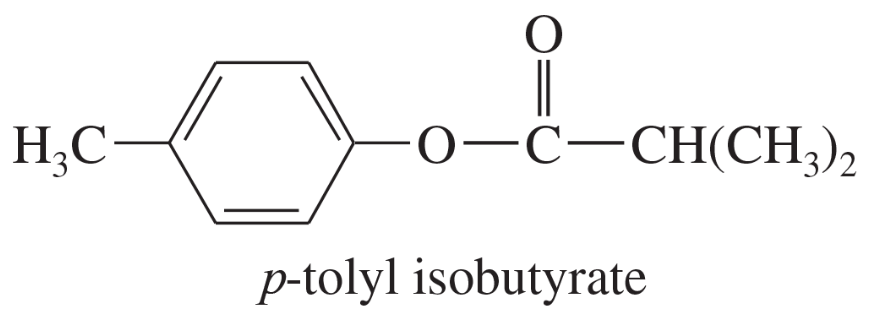
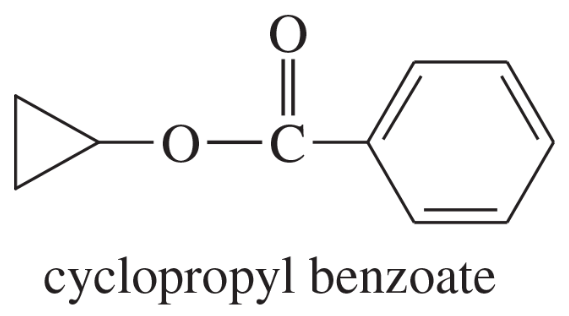
Show the alcohol and the acid chloride that combine to make the following esters.
(c)
(d)

Guida verificata passo dopo passo
1
Step 1: Identify the ester functional group in each compound. An ester is characterized by the structure R-O-C(=O)-R', where R and R' are organic groups. In the given compounds, the ester group connects an alcohol-derived part (R-O) and an acid chloride-derived part (C(=O)-R').
Step 2: For p-tolyl isobutyrate, observe the structure. The alcohol-derived part is the p-tolyl group (a benzene ring with a methyl group at the para position), and the acid chloride-derived part is isobutyric acid (CH(CH3)2-C(=O)-Cl).
Step 3: For cyclopropyl benzoate, observe the structure. The alcohol-derived part is the cyclopropyl group (a three-membered ring), and the acid chloride-derived part is benzoic acid (C6H5-C(=O)-Cl).
Step 4: Write the reaction for ester formation. Esters are formed by the reaction of an alcohol with an acid chloride in the presence of a base (e.g., pyridine) to neutralize the HCl byproduct. For p-tolyl isobutyrate, the reaction is: p-tolyl alcohol + isobutyryl chloride → p-tolyl isobutyrate + HCl. For cyclopropyl benzoate, the reaction is: cyclopropanol + benzoyl chloride → cyclopropyl benzoate + HCl.
Step 5: Confirm the alcohol and acid chloride components by matching the structural fragments in the ester. For p-tolyl isobutyrate, the alcohol is p-tolyl alcohol (C6H4(CH3)-OH), and the acid chloride is isobutyryl chloride (CH(CH3)2-C(=O)-Cl). For cyclopropyl benzoate, the alcohol is cyclopropanol (C3H5OH), and the acid chloride is benzoyl chloride (C6H5-C(=O)-Cl).

Risposta video verificata per un problema simile:

Questa soluzione video è stata consigliata dai nostri tutor come utile per risolvere questo problema.
Durata del video:
2m

Concetti chiave

Ecco i concetti essenziali che devi comprendere per rispondere correttamente alla domanda.

Esters Formation

Esters are formed through a reaction known as esterification, which typically involves the condensation of an alcohol and a carboxylic acid or an acid chloride. In this process, the hydroxyl group (-OH) from the alcohol and the hydrogen atom from the acid combine to release water, resulting in the formation of an ester bond.
Video consigliato:
02:39
Ester Nomenclature

Alcohols

Alcohols are organic compounds characterized by the presence of one or more hydroxyl (-OH) groups attached to a carbon atom. They can vary in structure, affecting their reactivity and the type of ester formed. Understanding the specific alcohol involved is crucial for predicting the properties of the resulting ester.
Video consigliato:
01:01
How to name alcohols

Acid Chlorides

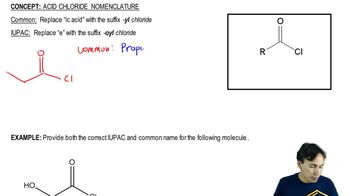
Acid chlorides, also known as acyl chlorides, are reactive derivatives of carboxylic acids where the hydroxyl group is replaced by a chlorine atom. They are highly reactive and can readily react with alcohols to form esters, making them important intermediates in organic synthesis. Identifying the correct acid chloride is essential for determining the ester product.
Video consigliato:
03:13
Acid Chloride Nomenclature