Ch. 12 - Infrared Spectroscopy and Mass Spectrometry
Wade - Organic Chemistry 9th Edition
Wade9th EditionOrganic ChemistryISBN: 9780135213728Non è quello che usi tu?Cambia libro di testo
Capitolo 12, Problema 2

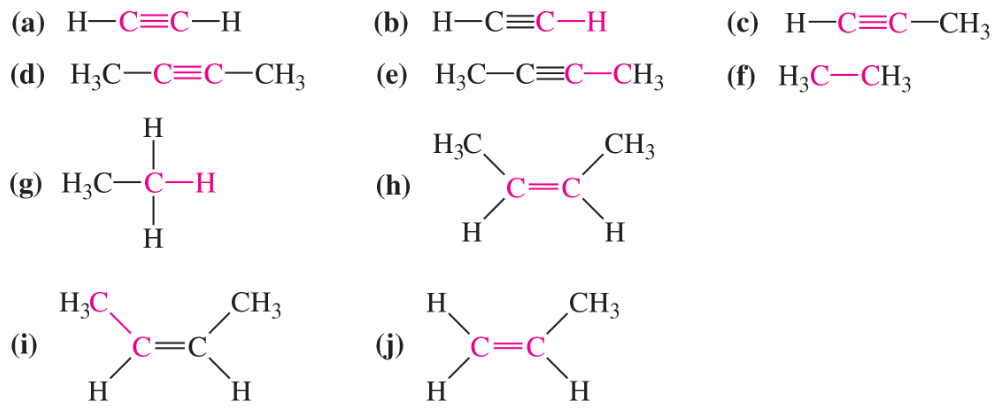
Which of the bonds shown in red are expected to have IR-active stretching frequencies?

Guida verificata passo dopo passo
1
Step 1: Understand the concept of IR-active bonds. A bond is IR-active if it has a dipole moment that changes during vibration. Symmetrical bonds or bonds with no dipole moment are typically IR-inactive.
Step 2: Analyze each structure provided in the images. Look for bonds shown in red or pink and determine if they involve atoms with differing electronegativities, which would create a dipole moment.
Step 3: For each bond, consider the symmetry of the molecule. If the bond is part of a symmetrical structure, it may not have a dipole moment change during vibration, making it IR-inactive.
Step 4: Evaluate the functional groups present. For example, triple bonds (C≡C) and double bonds (C=C) can be IR-active if they are part of an asymmetrical environment or involve polar bonds.
Step 5: Determine which bonds are IR-active based on the above criteria. For example, bonds like H-C≡C-H (structure a) are IR-active because the C-H bond has a dipole moment that changes during vibration, while symmetrical bonds like C≡C in a symmetrical environment may be IR-inactive.

Risposta video verificata per un problema simile:

Questa soluzione video è stata consigliata dai nostri tutor come utile per risolvere questo problema.
Durata del video:
7m

Concetti chiave

Ecco i concetti essenziali che devi comprendere per rispondere correttamente alla domanda.

Infrared (IR) Spectroscopy

Infrared spectroscopy is a technique used to identify molecular structures by measuring the absorption of infrared light, which causes molecular vibrations. Different types of bonds absorb IR radiation at characteristic frequencies, allowing chemists to deduce the presence of specific functional groups in a compound.
Video consigliato:
16:04
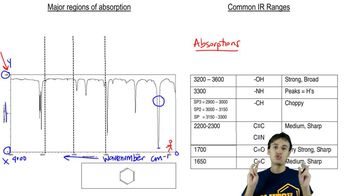
General Features of IR Spect

Molecular Vibrations

Molecular vibrations refer to the oscillations of atoms within a molecule around their equilibrium positions. These vibrations can be stretching (lengthening or shortening of bonds) or bending (change in bond angles), and only certain vibrations lead to changes in the dipole moment, making them IR-active.
Video consigliato:
08:41
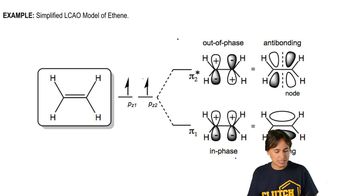
Review of Molecular Orbitals

IR-Active vs. IR-Inactive Bonds

A bond is considered IR-active if its vibration results in a change in the dipole moment of the molecule. For example, polar bonds typically exhibit IR activity, while symmetrical nonpolar bonds do not. Understanding which bonds are IR-active is crucial for interpreting IR spectra and identifying functional groups.
Video consigliato:
16:47
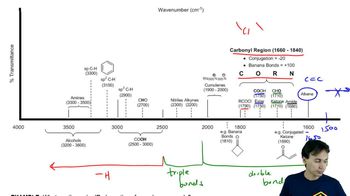
Common IR Frequencies