Ch. 15 - Conjugated Systems, Orbital Symmetry, and Ultraviolet Spectroscopy
Wade - Organic Chemistry 9th Edition
Wade9th EditionOrganic ChemistryISBN: 9780135213728Non è quello che usi tu?Cambia libro di testo
Capitolo 15, Problema 14f

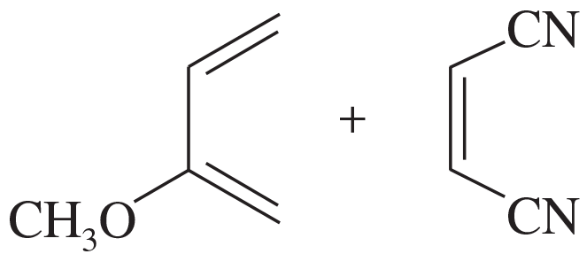
Predict the products of the following proposed Diels–Alder reactions.
(f)

Guida verificata passo dopo passo
1
Step 1: Identify the components of the Diels–Alder reaction. The reaction involves a conjugated diene (CH3O-substituted diene) and a dienophile (cyano-substituted alkene). The diene has two double bonds in conjugation, and the dienophile has electron-withdrawing cyano groups that enhance its reactivity.
Step 2: Analyze the electron flow in the reaction. The Diels–Alder reaction is a [4+2] cycloaddition, where the diene contributes four π-electrons and the dienophile contributes two π-electrons. The reaction proceeds via a concerted mechanism, forming a six-membered ring.
Step 3: Determine the regiochemistry of the reaction. The electron-donating methoxy group (-OCH3) on the diene will direct the reaction due to its electronic effects. The cyano groups (-CN) on the dienophile are electron-withdrawing, influencing the orientation of the addition. The most stable product will result from the alignment of these groups to minimize steric hindrance and maximize electronic compatibility.
Step 4: Predict the stereochemistry of the product. The Diels–Alder reaction is stereospecific, meaning that the stereochemistry of the diene and dienophile is preserved in the product. If the diene and dienophile are planar, the product will have cis substituents on the newly formed six-membered ring.
Step 5: Draw the product structure. Combine the diene and dienophile to form a six-membered ring. The methoxy group (-OCH3) and cyano groups (-CN) will be positioned based on the regio- and stereochemical considerations discussed. Ensure the product reflects the correct connectivity and stereochemistry.

Risposta video verificata per un problema simile:

Questa soluzione video è stata consigliata dai nostri tutor come utile per risolvere questo problema.
Durata del video:
4m

Concetti chiave

Ecco i concetti essenziali che devi comprendere per rispondere correttamente alla domanda.

Diels–Alder Reaction

The Diels–Alder reaction is a [4+2] cycloaddition reaction between a conjugated diene and a dienophile, resulting in the formation of a six-membered ring. This reaction is a key method in organic synthesis for constructing cyclic compounds and is characterized by its stereospecificity and regioselectivity, making it a powerful tool for chemists.
Video consigliato:
04:02
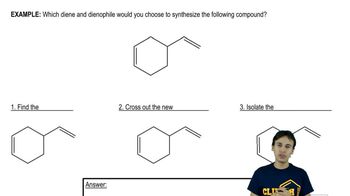
Diels-Alder Retrosynthesis

Diene and Dienophile

In the context of the Diels–Alder reaction, a diene is a molecule containing two double bonds that can participate in the reaction, while a dienophile is a compound that contains a double or triple bond and reacts with the diene. The electronic and steric properties of both the diene and dienophile significantly influence the reaction's outcome, including product formation and selectivity.
Video consigliato:
04:43
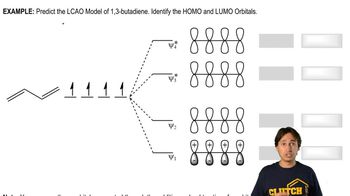
Drawing MO Diagram for Dienes

Regioselectivity and Stereochemistry

Regioselectivity refers to the preference of a chemical reaction to yield one structural isomer over others, while stereochemistry involves the spatial arrangement of atoms in the resulting product. In Diels–Alder reactions, the orientation of substituents on the diene and dienophile can lead to different regioisomers and stereoisomers, which are crucial for predicting the final products of the reaction.
Video consigliato:
Percorso guidato
1:38
Polymer Stereochemistry Concept 1