Ch. 15 - Conjugated Systems, Orbital Symmetry, and Ultraviolet Spectroscopy
Wade - Organic Chemistry 9th Edition
Wade9th EditionOrganic ChemistryISBN: 9780135213728Non è quello che usi tu?Cambia libro di testo
Capitolo 15, Problema 25d

Predict the products of the following reactions.
(d) furan + trans-1,2-dicyanoethylene

Guida verificata passo dopo passo
1
Step 1: Identify the reactants. Furan is a five-membered aromatic heterocyclic compound containing oxygen. The second reactant is trans-1,2-dicyanoethylene, which is an alkene with two cyano groups (-CN) attached to the double bond in a trans configuration.
Step 2: Recognize the type of reaction. Furan, being an electron-rich aromatic compound, can undergo a Diels-Alder reaction with electron-deficient alkenes like trans-1,2-dicyanoethylene. The cyano groups make the alkene highly electrophilic, favoring cycloaddition.
Step 3: Predict the mechanism. In the Diels-Alder reaction, the π-electrons of furan interact with the π-electrons of the alkene to form a new six-membered ring. This reaction proceeds via a concerted mechanism, where bonds are formed simultaneously.
Step 4: Determine the stereochemistry. Since the alkene is trans, the substituents (cyano groups) will retain their relative trans configuration in the product. The newly formed six-membered ring will have the cyano groups positioned opposite to each other.
Step 5: Draw the product structure. The product will be a bicyclic compound where the furan and alkene have combined to form a six-membered ring fused to the original furan ring. The cyano groups will be attached to the new ring in a trans configuration.

Risposta video verificata per un problema simile:

Questa soluzione video è stata consigliata dai nostri tutor come utile per risolvere questo problema.
Durata del video:
3m

Concetti chiave

Ecco i concetti essenziali che devi comprendere per rispondere correttamente alla domanda.

Electrophilic Addition

Electrophilic addition is a fundamental reaction mechanism in organic chemistry where an electrophile reacts with a nucleophile, resulting in the formation of a new bond. In this case, furan, which contains a nucleophilic double bond, can react with the electrophilic trans-1,2-dicyanoethylene. Understanding this mechanism is crucial for predicting the products of the reaction.
Video consigliato:
09:23
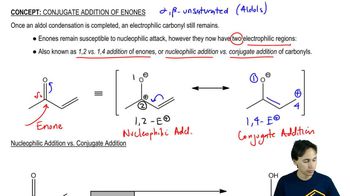
1,2 vs 1,4 Addition

Aromaticity and Reactivity

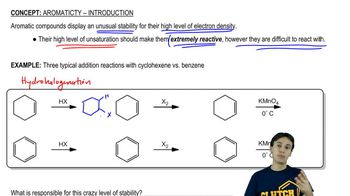
Furan is an aromatic compound, which means it has a cyclic structure with delocalized π electrons that contribute to its stability. However, furan is more reactive than benzene due to the presence of an oxygen atom in the ring, which can influence its reactivity towards electrophiles. Recognizing the balance between aromatic stability and reactivity is essential for predicting the outcome of the reaction.
Video consigliato:
08:19
Intro to Aromaticity

Diels-Alder Reaction

The Diels-Alder reaction is a [4+2] cycloaddition reaction between a diene and a dienophile, leading to the formation of a six-membered ring. In this scenario, furan acts as the diene, while trans-1,2-dicyanoethylene serves as the dienophile. Familiarity with this reaction type is vital for understanding how the products are formed from the reactants in the given question.
Video consigliato:
04:02
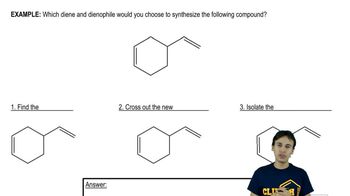
Diels-Alder Retrosynthesis