Ch. 15 - Conjugated Systems, Orbital Symmetry, and Ultraviolet Spectroscopy
Wade - Organic Chemistry 9th Edition
Wade9th EditionOrganic ChemistryISBN: 9780135213728Non è quello che usi tu?Cambia libro di testo
Capitolo 15, Problema 1a

Rank each group of compounds in order of increasing heat of hydrogenation.
(a) hexa-1,2-diene; hexa-1,3,5-triene; hexa-1,3-diene; hexa-1,4-diene; hexa-1,5-diene; hexa-2,4-diene

Guida verificata passo dopo passo
1
Step 1: Understand the concept of heat of hydrogenation. Heat of hydrogenation is the energy released when a molecule undergoes hydrogenation (addition of H₂ across double bonds). Molecules with more stable double bonds (due to conjugation or resonance) will have lower heats of hydrogenation.
Step 2: Analyze the structures provided. The compounds are hexa-1,2-diene, hexa-1,3,5-triene, hexa-1,3-diene, hexa-1,4-diene, hexa-1,5-diene, and hexa-2,4-diene. Note the number and arrangement of double bonds in each structure.
Step 3: Identify conjugation in the molecules. Conjugated double bonds (alternating single and double bonds) are more stable due to delocalization of π-electrons. For example, hexa-1,3,5-triene has fully conjugated double bonds, making it the most stable and thus having the lowest heat of hydrogenation.
Step 4: Rank the compounds based on stability. Molecules with isolated double bonds (e.g., hexa-1,2-diene) are less stable and will have higher heats of hydrogenation. Partially conjugated systems (e.g., hexa-1,3-diene, hexa-1,4-diene, hexa-1,5-diene, hexa-2,4-diene) will have intermediate heats of hydrogenation.
Step 5: Arrange the compounds in order of increasing heat of hydrogenation: hexa-1,3,5-triene (lowest heat of hydrogenation due to full conjugation), followed by partially conjugated systems (hexa-1,3-diene, hexa-1,4-diene, hexa-1,5-diene, hexa-2,4-diene), and finally hexa-1,2-diene (highest heat of hydrogenation due to isolated double bonds).

Risposta video verificata per un problema simile:

Questa soluzione video è stata consigliata dai nostri tutor come utile per risolvere questo problema.
Durata del video:
9m

Concetti chiave

Ecco i concetti essenziali che devi comprendere per rispondere correttamente alla domanda.

Heat of Hydrogenation

The heat of hydrogenation is the amount of energy released when an alkene is converted to an alkane through the addition of hydrogen. This value is indicative of the stability of the alkene; more stable alkenes release less heat upon hydrogenation. Thus, the heat of hydrogenation can be used to compare the relative stabilities of different alkenes, with less heat indicating greater stability.
Video consigliato:
00:48
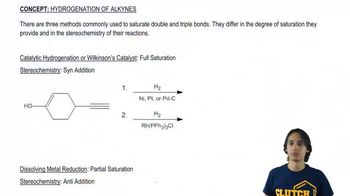
The definition of hydrogenation.

Alkene Stability and Substitution

Alkene stability is influenced by the degree of substitution at the double bond. More substituted alkenes (those with more alkyl groups attached to the carbon atoms of the double bond) are generally more stable due to hyperconjugation and the inductive effect. This stability affects the heat of hydrogenation, where more substituted alkenes will have a lower heat of hydrogenation compared to less substituted ones.
Video consigliato:
04:28
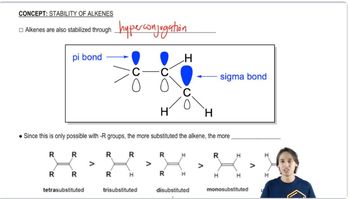
Understanding trends of alkene stability.

Conjugation and Resonance

Conjugation occurs when double bonds are separated by a single bond, allowing for delocalization of π electrons across the molecule. This delocalization stabilizes the alkene, leading to lower heat of hydrogenation. Resonance structures can also contribute to the stability of certain alkenes, making them less reactive and thus requiring less energy to hydrogenate.
Video consigliato:
05:29
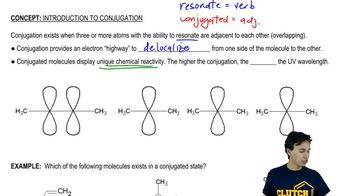
Definition of Conjugation