


Ch. 17 - Reactions of Aromatic Compounds
Wade - Organic Chemistry 9th Edition
Wade9th EditionOrganic ChemistryISBN: 9780135213728Non è quello che usi tu?Cambia libro di testo
Capitolo 17, Problema 14b(vi)

Biphenyl is two benzene rings joined by a single bond. The site of substitution for a biphenyl is determined by (1) which phenyl ring is more activated (or less deactivated), and (2) which position on that ring is most reactive, using the fact that a phenyl substituent is activating and ortho, para-directing.
b. Predict the mononitration products of the following compounds
(vi)

Guida verificata passo dopo passo
1
Analyze the structure of the biphenyl compound provided. The molecule consists of two benzene rings connected by a single bond. One ring has a hydroxyl (-OH) group, which is an activating group and ortho/para-directing. The other ring has a ketone (-COCH3) group, which is a deactivating group and meta-directing.
Determine which phenyl ring is more activated. The hydroxyl group is an electron-donating group, making the ring it is attached to more reactive toward electrophilic substitution. The ketone group is electron-withdrawing, making its ring less reactive.
Focus on the hydroxyl-substituted ring for the nitration reaction. Since the hydroxyl group is ortho/para-directing, the nitro group (-NO2) will preferentially substitute at the ortho or para positions relative to the hydroxyl group.
Consider steric hindrance and electronic effects. The para position relative to the hydroxyl group is less sterically hindered compared to the ortho positions, making it the most likely site for substitution.
Predict the mononitration product. The nitro group will substitute at the para position of the hydroxyl-substituted phenyl ring, resulting in a compound where the nitro group is directly opposite the hydroxyl group on the same benzene ring.

Risposta video verificata per un problema simile:

Questa soluzione video è stata consigliata dai nostri tutor come utile per risolvere questo problema.
Durata del video:
6m

Concetti chiave

Ecco i concetti essenziali che devi comprendere per rispondere correttamente alla domanda.

Electrophilic Aromatic Substitution (EAS)

Electrophilic Aromatic Substitution is a fundamental reaction in organic chemistry where an electrophile replaces a hydrogen atom on an aromatic ring. This reaction is crucial for modifying aromatic compounds, such as biphenyl, and is influenced by the substituents already present on the ring, which can either activate or deactivate the ring towards further substitution.
Video consigliato:
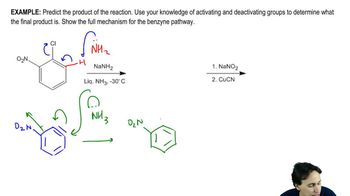
03:07
EAS Review

Activating and Deactivating Groups

Substituents on an aromatic ring can be classified as activating or deactivating based on their electronic effects. Activating groups, like hydroxyl (-OH), increase the electron density of the ring, making it more reactive towards electrophiles. Conversely, deactivating groups withdraw electron density, making the ring less reactive. Understanding these effects is essential for predicting the site of substitution in reactions like nitration.
Video consigliato:
03:27
Activating and deactivating groups

Ortho/Para-Directing Effects

In EAS reactions, substituents can direct incoming electrophiles to specific positions on the aromatic ring. Ortho and para directing groups, such as -OH, favor substitution at the ortho and para positions relative to themselves. This directing effect is vital for predicting the products of reactions involving biphenyl, as it determines where the new substituent will be added on the ring.
Video consigliato:
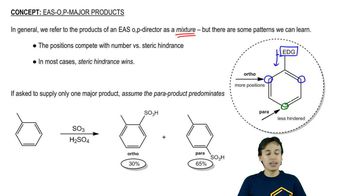
04:42
Ortho, Para major products
Pratica correlata
Domanda del libro di testo

Biphenyl is two benzene rings joined by a single bond. The site of substitution for a biphenyl is determined by (1) which phenyl ring is more activated (or less deactivated), and (2) which position on that ring is most reactive, using the fact that a phenyl substituent is activating and ortho, para-directing.

b. Predict the mononitration products of the following compounds

(v)

1376
views
Domanda del libro di testo

Predict the mononitration products of the following compounds.

f. o-hydroxyacetophenone

976
views
Domanda del libro di testo

Biphenyl is two benzene rings joined by a single bond. The site of substitution for a biphenyl is determined by (1) which phenyl ring is more activated (or less deactivated), and (2) which position on that ring is most reactive, using the fact that a phenyl substituent is activating and ortho, para-directing.

b. Predict the mononitration products of the following compounds

(i)

687
views
Domanda del libro di testo

Biphenyl is two benzene rings joined by a single bond. The site of substitution for a biphenyl is determined by (1) which phenyl ring is more activated (or less deactivated), and (2) which position on that ring is most reactive, using the fact that a phenyl substituent is activating and ortho, para-directing.

b. Predict the mononitration products of the following compounds

(ii)

327
views
Domanda del libro di testo

Biphenyl is two benzene rings joined by a single bond. The site of substitution for a biphenyl is determined by (1) which phenyl ring is more activated (or less deactivated), and (2) which position on that ring is most reactive, using the fact that a phenyl substituent is activating and ortho, para-directing.

a. Use resonance forms of a sigma complex to show why a phenyl substituent should be ortho, para-directing.

(vi)

640
views
Domanda del libro di testo

Biphenyl is two benzene rings joined by a single bond. The site of substitution for a biphenyl is determined by (1) which phenyl ring is more activated (or less deactivated), and (2) which position on that ring is most reactive, using the fact that a phenyl substituent is activating and ortho, para-directing.

a. Use resonance forms of a sigma complex to show why a phenyl substituent should be ortho, para-directing.

(i)

3946
views