Ch. 17 - Reactions of Aromatic Compounds
Wade - Organic Chemistry 9th Edition
Wade9th EditionOrganic ChemistryISBN: 9780135213728Non è quello che usi tu?Cambia libro di testo
Capitolo 17, Problema 57d

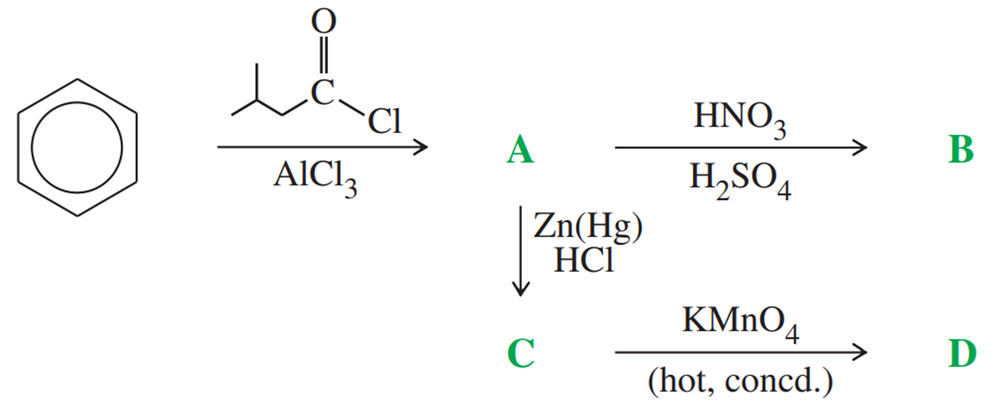
Give the structures of compounds C through D in the following series of reactions.

Guida verificata passo dopo passo
1
Step 1: Analyze the first reaction. The benzene ring reacts with an acyl chloride (CH3CH2COCl) in the presence of AlCl3, a Lewis acid catalyst. This is a Friedel-Crafts acylation reaction, which introduces an acyl group (CH3CH2CO-) onto the benzene ring, forming compound A.
Step 2: Examine the second reaction. Compound A undergoes nitration using HNO3 and H2SO4. This introduces a nitro group (-NO2) onto the benzene ring, typically at the meta position relative to the acyl group due to the electron-withdrawing nature of the acyl group, forming compound B.
Step 3: Consider the third reaction. Compound B is treated with Zn(Hg) and HCl, which is a Clemmensen reduction. This reduces the acyl group (CH3CH2CO-) to an alkyl group (CH3CH2-), forming compound C.
Step 4: Analyze the final reaction. Compound C is oxidized using hot, concentrated KMnO4. This strong oxidizing agent converts the alkyl group (CH3CH2-) attached to the benzene ring into a carboxylic acid group (-COOH), forming compound D.
Step 5: Summarize the transformations. Compound A is formed via Friedel-Crafts acylation, compound B via nitration, compound C via Clemmensen reduction, and compound D via oxidation with KMnO4. Each step involves a specific functional group transformation on the benzene ring.

Risposta video verificata per un problema simile:

Questa soluzione video è stata consigliata dai nostri tutor come utile per risolvere questo problema.
Durata del video:
2m

Concetti chiave

Ecco i concetti essenziali che devi comprendere per rispondere correttamente alla domanda.

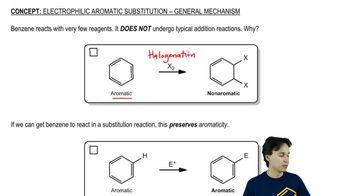
Electrophilic Aromatic Substitution

Electrophilic aromatic substitution (EAS) is a fundamental reaction in organic chemistry where an electrophile replaces a hydrogen atom on an aromatic ring. In this reaction, the aromatic compound acts as a nucleophile, attacking the electrophile, which leads to the formation of a new bond. The presence of a catalyst, such as AlCl3, is often required to generate a more reactive electrophile, facilitating the substitution process.
Video consigliato:
03:07
EAS Review

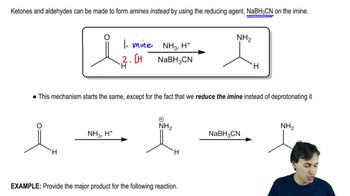
Reduction Reactions

Reduction reactions involve the gain of electrons or the decrease in oxidation state by a molecule. In the context of organic chemistry, this often refers to the conversion of carbonyl compounds to alcohols or alkenes. The reaction shown with Zn(Hg) and HCl indicates a reduction process, where a carbonyl group is reduced to an alkane, typically through a Clemmensen reduction, which is useful for transforming ketones or aldehydes into hydrocarbons.
Video consigliato:
07:12
Reductive Amination

Oxidation Reactions

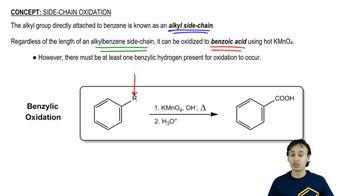
Oxidation reactions in organic chemistry involve the loss of electrons or an increase in oxidation state, often resulting in the conversion of alcohols to carbonyl compounds or carboxylic acids. The use of KMnO4 in hot, concentrated conditions indicates a strong oxidizing environment, which can oxidize alcohols to carboxylic acids or aldehydes to carboxylic acids, depending on the starting material. This step is crucial for understanding the transformation from compound C to D in the reaction sequence.
Video consigliato:
03:20
Benzylic Oxidation