Ch. 22 - Condensations and Alpha Substitutions of Carbonyl Compounds
Wade - Organic Chemistry 9th Edition
Wade9th EditionOrganic ChemistryISBN: 9780135213728Non è quello che usi tu?Cambia libro di testo
Capitolo 22, Problema 2a

Show each step in the mechanism of the acid-catalyzed interconversion of (R)- and (S)-3-methylpentan-2-one.

Guida verificata passo dopo passo
1
Step 1: Protonation of the carbonyl oxygen - In the presence of an acid catalyst, the lone pair of electrons on the oxygen atom of the carbonyl group in 3-methylpentan-2-one interacts with a proton (H⁺). This results in the formation of a protonated carbonyl intermediate, making the carbonyl carbon more electrophilic.
Step 2: Formation of the enol intermediate - A base (such as water or the conjugate base of the acid) abstracts a proton from the alpha-carbon (the carbon adjacent to the carbonyl group). This deprotonation leads to the formation of a double bond between the alpha-carbon and the carbonyl carbon, while the oxygen atom retains a lone pair of electrons, forming an enol intermediate.
Step 3: Reprotonation of the enol - The enol intermediate undergoes protonation at the oxygen atom, resulting in the formation of a protonated enol. This step is reversible and depends on the acidic environment.
Step 4: Tautomerization to the ketone - The protonated enol undergoes tautomerization, where the double bond between the alpha-carbon and the carbonyl carbon is broken, and a proton is transferred to the alpha-carbon. This regenerates the carbonyl group, forming the ketone. During this step, the stereochemistry at the alpha-carbon can invert, leading to the interconversion of the (R)- and (S)-enantiomers.
Step 5: Deprotonation to regenerate the catalyst - The final step involves the deprotonation of the protonated carbonyl group by a base, regenerating the acid catalyst and yielding the neutral ketone product. This completes the acid-catalyzed interconversion of (R)- and (S)-3-methylpentan-2-one.

Risposta video verificata per un problema simile:

Questa soluzione video è stata consigliata dai nostri tutor come utile per risolvere questo problema.
Durata del video:
6m

Concetti chiave

Ecco i concetti essenziali che devi comprendere per rispondere correttamente alla domanda.

Acid-Catalyzed Mechanism

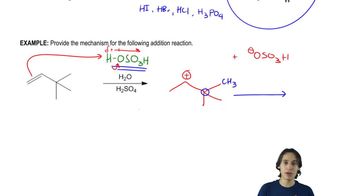
An acid-catalyzed mechanism involves the use of an acid to facilitate a chemical reaction. In this context, the acid donates a proton (H+) to the carbonyl oxygen of the ketone, increasing its electrophilicity. This step is crucial for the subsequent nucleophilic attack by water or alcohol, leading to the formation of a tetrahedral intermediate, which can then rearrange to yield the desired enantiomer.
Video consigliato:
06:34
Acid-catalyzed hydration mechanism

Stereochemistry and Enantiomers

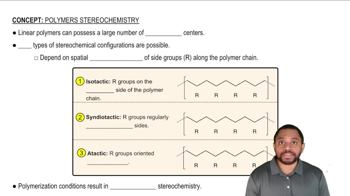
Stereochemistry is the study of the spatial arrangement of atoms in molecules and how this affects their chemical behavior. Enantiomers are pairs of molecules that are non-superimposable mirror images of each other, such as (R)- and (S)-3-methylpentan-2-one. Understanding the stereochemical implications of the reaction is essential for analyzing how the acid-catalyzed mechanism leads to the interconversion of these two enantiomers.
Video consigliato:
Percorso guidato
1:38
Polymer Stereochemistry Concept 1

Tetrahedral Intermediate

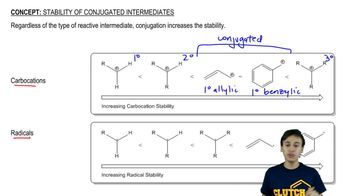
A tetrahedral intermediate is a transient species formed during nucleophilic addition to a carbonyl compound. In the case of the acid-catalyzed interconversion, the addition of water to the protonated carbonyl creates this intermediate, which can undergo further reactions. Recognizing the formation and stability of this intermediate is key to understanding the mechanism and the pathway leading to the final products.
Video consigliato:
04:31
Stability of Conjugated Intermediates