Ch. 22 - Condensations and Alpha Substitutions of Carbonyl Compounds
Wade - Organic Chemistry 9th Edition
Wade9th EditionOrganic ChemistryISBN: 9780135213728Non è quello che usi tu?Cambia libro di testo
Capitolo 22, Problema 28a

Predict the major products of the following base-catalyzed aldol condensations with dehydration.
(a) benzophenone (PhCOPh) + propionaldehyde

Guida verificata passo dopo passo
1
Identify the enolate-forming compound: In a base-catalyzed aldol condensation, the compound with an alpha-hydrogen will form the enolate ion. In this case, propionaldehyde (CH3CH2CHO) has alpha-hydrogens, while benzophenone (PhCOPh) does not. Therefore, propionaldehyde will form the enolate.
Generate the enolate ion: The base (e.g., OH⁻) will abstract an alpha-hydrogen from propionaldehyde, forming the enolate ion. The enolate ion is a resonance-stabilized species with a negative charge on the alpha-carbon and a delocalized electron pair on the oxygen.
Perform the nucleophilic attack: The enolate ion acts as a nucleophile and attacks the carbonyl carbon of benzophenone (PhCOPh), which is electrophilic. This forms a beta-hydroxy intermediate (a compound with a hydroxyl group on the beta-carbon relative to the original carbonyl group).
Dehydrate the beta-hydroxy intermediate: Under base-catalyzed conditions, the beta-hydroxy intermediate undergoes elimination of water (dehydration) to form an α,β-unsaturated carbonyl compound. This step involves the removal of a hydroxyl group and a beta-hydrogen, resulting in the formation of a double bond between the alpha and beta carbons.
Predict the major product: The final product is an α,β-unsaturated ketone, where the benzophenone moiety (PhCO-) is conjugated with the double bond formed during dehydration. The structure of the product will include the benzophenone group and the extended conjugated system from the propionaldehyde.

Risposta video verificata per un problema simile:

Questa soluzione video è stata consigliata dai nostri tutor come utile per risolvere questo problema.
Durata del video:
3m

Concetti chiave

Ecco i concetti essenziali che devi comprendere per rispondere correttamente alla domanda.

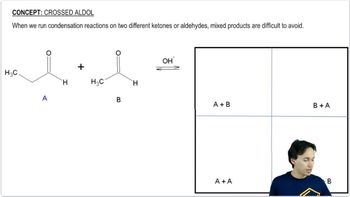
Aldol Condensation

Aldol condensation is a reaction between aldehydes or ketones that contain alpha-hydrogens, leading to the formation of β-hydroxy aldehydes or ketones. This reaction involves the nucleophilic addition of an enolate ion to a carbonyl compound, followed by dehydration to yield an α,β-unsaturated carbonyl compound. Understanding this process is crucial for predicting the products of the reaction.
Video consigliato:
09:51
Crossed Aldol

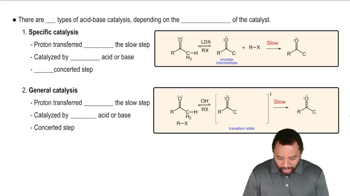
Base Catalysis

Base catalysis involves the use of a base to facilitate a chemical reaction, often by deprotonating a molecule to form a more reactive species. In aldol condensations, a strong base can generate an enolate ion from an aldehyde or ketone, which then acts as a nucleophile. Recognizing the role of the base is essential for understanding how the reaction proceeds and the products formed.
Video consigliato:
Percorso guidato
2:50
Acid-Base Catalysis Concept 3

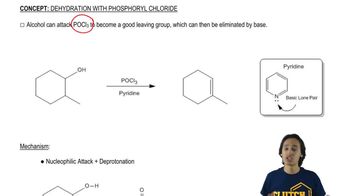
Dehydration in Organic Reactions

Dehydration in organic chemistry refers to the elimination of water from a compound, often occurring after the formation of an intermediate. In the context of aldol condensation, after the formation of the β-hydroxy carbonyl compound, dehydration leads to the formation of a double bond, resulting in an α,β-unsaturated carbonyl compound. This step is critical for determining the final products of the reaction.
Video consigliato:
01:23
General Reaction of Dehydration with POCl3