Ch. 22 - Condensations and Alpha Substitutions of Carbonyl Compounds
Wade - Organic Chemistry 9th Edition
Wade9th EditionOrganic ChemistryISBN: 9780135213728Non è quello che usi tu?Cambia libro di testo
Capitolo 22, Problema 38a

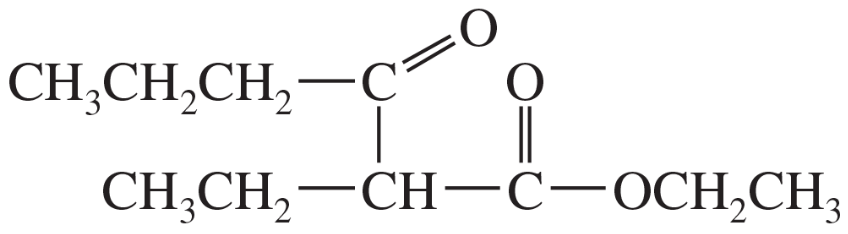
Show what esters would undergo Claisen condensation to give the following β-keto esters.
(a)

Guida verificata passo dopo passo
1
Step 1: Identify the β-keto ester structure in the given compound. The β-keto ester contains a ketone group (C=O) at the β-position relative to the ester group (COOR). In this case, the compound has a ketone group adjacent to the ester group.
Step 2: Recall the Claisen condensation reaction mechanism. This reaction involves two ester molecules reacting in the presence of a strong base (such as alkoxide) to form a β-keto ester. One ester acts as the nucleophile, and the other acts as the electrophile.
Step 3: Analyze the structure of the product to deduce the esters that could combine to form it. The β-keto ester shown has two distinct alkyl groups attached to the carbonyl carbons. This suggests that two different esters were involved in the reaction.
Step 4: Break down the β-keto ester into its possible precursor esters. The ester group (COOR) and the ketone group (C=O) originate from two separate esters. For this compound, one ester likely contributes the ethyl group (CH2CH3), while the other contributes the propyl group (CH2CH2CH3).
Step 5: Write the structures of the two esters that would undergo Claisen condensation. The first ester is ethyl propanoate (CH3CH2CH2COOCH2CH3), and the second ester is ethyl acetate (CH3COOCH2CH3). These two esters react under basic conditions to form the given β-keto ester.

Risposta video verificata per un problema simile:

Questa soluzione video è stata consigliata dai nostri tutor come utile per risolvere questo problema.
Durata del video:
4m

Concetti chiave

Ecco i concetti essenziali che devi comprendere per rispondere correttamente alla domanda.

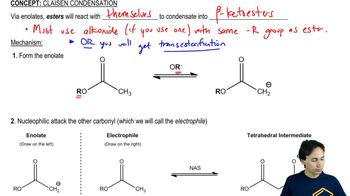
Claisen Condensation

Claisen condensation is a reaction between two esters or an ester and a carbonyl compound in the presence of a strong base, typically sodium ethoxide. This reaction results in the formation of a β-keto ester or a β-diketone. The process involves the deprotonation of an alpha hydrogen on one ester, allowing it to act as a nucleophile and attack the carbonyl carbon of another ester, leading to the formation of a new carbon-carbon bond.
Video consigliato:
08:28
Claisen Condensation

β-Keto Esters

β-Keto esters are compounds that contain both a ketone and an ester functional group, with the carbonyl of the ketone located at the beta position relative to the ester group. These compounds are significant in organic synthesis as they can undergo further reactions, such as decarboxylation or aldol condensation, to form more complex molecules. Their structure allows for various reactivity patterns due to the presence of both functional groups.
Video consigliato:
02:39
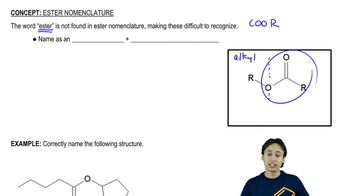
Ester Nomenclature

Alpha Hydrogen

Alpha hydrogens are the hydrogen atoms attached to the carbon atom adjacent to a carbonyl group in a molecule. In the context of Claisen condensation, these hydrogens are crucial because they can be deprotonated by a strong base, generating a nucleophilic enolate ion. This enolate ion is essential for the reaction to proceed, as it attacks the carbonyl carbon of another ester, facilitating the formation of the β-keto ester.
Video consigliato:
00:48
The definition of hydrogenation.