Ch. 23 - Carbohydrates and Nucleic Acids
Wade - Organic Chemistry 9th Edition
Wade9th EditionOrganic ChemistryISBN: 9780135213728Non è quello che usi tu?Cambia libro di testo
Capitolo 23, Problema 30

D-Lyxose is formed by Ruff degradation of galactose. Give the structure of D-lyxose. Ruff degradation of D-lyxose gives D-threose. Give the structure of D-threose.

Guida verificata passo dopo passo
1
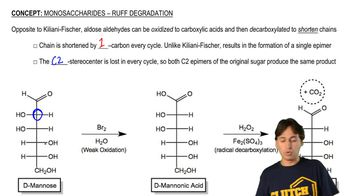
Understand the Ruff degradation process: Ruff degradation is a method used to shorten the carbon chain of an aldose sugar by one carbon atom. It involves oxidation of the aldose to an aldonic acid, followed by decarboxylation to yield a new aldose with one fewer carbon atom.
Start with D-galactose: Write the Fischer projection of D-galactose, which is an aldohexose (6-carbon sugar) with the configuration (from top to bottom): HO-C-H, H-C-OH, H-C-OH, HO-C-H, CH2OH.
Apply Ruff degradation to D-galactose: Oxidize the aldehyde group (-CHO) of D-galactose to a carboxylic acid (-COOH) to form D-galactonic acid. Then, decarboxylate the carboxylic acid group to remove one carbon atom, resulting in D-lyxose, an aldopentose (5-carbon sugar). Write the Fischer projection of D-lyxose, which has the configuration: HO-C-H, H-C-OH, H-C-OH, CH2OH.
Understand the second Ruff degradation: Apply the same Ruff degradation process to D-lyxose. Oxidize the aldehyde group of D-lyxose to form D-lyxonic acid, then decarboxylate to remove one carbon atom, yielding D-threose, an aldotetrose (4-carbon sugar).
Write the Fischer projection of D-threose: D-threose has the configuration: H-C-OH, H-C-OH, CH2OH. This is the final structure obtained after the second Ruff degradation.

Risposta video verificata per un problema simile:

Questa soluzione video è stata consigliata dai nostri tutor come utile per risolvere questo problema.
Durata del video:
5m

Concetti chiave

Ecco i concetti essenziali che devi comprendere per rispondere correttamente alla domanda.

Ruff Degradation

Ruff degradation is a chemical reaction that involves the oxidative cleavage of aldoses, typically using bromine and water, to yield a ketose. This process transforms an aldose sugar into a different sugar, often resulting in a sugar with fewer carbon atoms. Understanding this reaction is crucial for predicting the products formed from specific aldoses, such as galactose leading to D-lyxose.
Video consigliato:
06:18
Monosaccharides - Ruff Degradation

Sugar Structures

The structure of sugars, including their stereochemistry, is fundamental in organic chemistry. D-lyxose and D-threose are both pentoses, meaning they contain five carbon atoms, and their structures differ in the arrangement of hydroxyl groups around the chiral centers. Recognizing how to draw and interpret these structures is essential for understanding their chemical behavior and transformations.
Video consigliato:
02:21
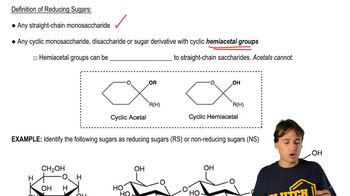
Reducing Sugars

Stereochemistry

Stereochemistry refers to the study of the spatial arrangement of atoms in molecules and how this affects their chemical properties. In the case of D-lyxose and D-threose, the specific orientation of hydroxyl groups determines their identity and reactivity. Mastery of stereochemical concepts is vital for predicting the outcomes of reactions involving these sugars.
Video consigliato:
Percorso guidato
1:38
Polymer Stereochemistry Concept 1
Pratica correlata
Domanda del libro di testo

Predict the products formed when the following sugars react with excess acetic anhydride and pyridine.

(a) α-D-glucopyranose

1134
views

Domanda del libro di testo

The Wohl degradation, an alternative to the Ruff degradation, is nearly the reverse of the Kiliani–Fischer synthesis. The aldose carbonyl group is converted to the oxime, which is dehydrated by acetic anhydride to the nitrile (a cyanohydrin). Cyanohydrin formation is reversible, and a basic hydrolysis allows the cyanohydrin to lose HCN. Using the following sequence of reagents, give equations for the individual reactions in the Wohl degradation of D-arabinose to D-erythrose. Mechanisms are not required.

a. hydroxylamine hydrochloride

b. acetic anhydride

c. –OH, H2O

1777
views
Domanda del libro di testo

Ruff degradation of D-arabinose gives D-erythrose. The Kiliani–Fischer synthesis converts D-erythrose to a mixture of D-arabinose and D-ribose. Draw out these reactions, and give the structure of D-ribose.

1050
views
Domanda del libro di testo

D-Altrose is an aldohexose. Ruff degradation of D-altrose gives the same aldopentose as does degradation of D-allose, the C3 epimer of glucose. Give the structure of D-altrose.

1211
views
Domanda del libro di testo

Show that Ruff degradation of D-mannose gives the same aldopentose (D-arabinose) as does D-glucose.

1652
views
1
rank
Domanda del libro di testo

Predict the products formed when the following sugars react with excess acetic anhydride and pyridine.

(b) β-D-ribofuranose

583
views