Ch. 23 - Carbohydrates and Nucleic Acids
Wade - Organic Chemistry 9th Edition
Wade9th EditionOrganic ChemistryISBN: 9780135213728Non è quello che usi tu?Cambia libro di testo
Capitolo 23, Problema 27b

Draw the expected product of the reaction of the following sugars with excess methyl iodide and silver oxide.
(b) β-D-galactopyranose

Guida verificata passo dopo passo
1
Identify the functional groups in β-D-galactopyranose that can react with methyl iodide (CH₃I) in the presence of silver oxide (Ag₂O). These include the hydroxyl (-OH) groups and the anomeric hydroxyl group.
Understand the reaction mechanism: Methyl iodide acts as a methylating agent, and silver oxide facilitates the deprotonation of hydroxyl groups, allowing them to be methylated. Each hydroxyl group will be converted into a methoxy (-OCH₃) group.
Determine the stereochemistry of β-D-galactopyranose. The β-anomer means the anomeric hydroxyl group is in the equatorial position. This stereochemistry will be retained in the product.
Replace all hydroxyl (-OH) groups, including the anomeric hydroxyl group, with methoxy (-OCH₃) groups. Ensure that the stereochemistry of the sugar ring is preserved during this substitution.
Draw the final structure of the fully methylated β-D-galactopyranose, where all hydroxyl groups have been replaced with methoxy groups, and confirm that the stereochemistry of the sugar ring is consistent with the original β-anomer.

Risposta video verificata per un problema simile:

Questa soluzione video è stata consigliata dai nostri tutor come utile per risolvere questo problema.
Durata del video:
2m

Concetti chiave

Ecco i concetti essenziali che devi comprendere per rispondere correttamente alla domanda.

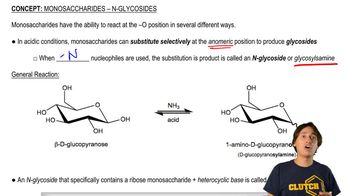
Glycosylation Reaction

Glycosylation is a chemical reaction where a sugar molecule (glycosyl donor) reacts with an alcohol or another sugar (glycosyl acceptor) to form a glycosidic bond. In this context, the reaction of b-D-galactopyranose with methyl iodide involves the substitution of the hydroxyl group on the sugar with a methyl group, leading to the formation of a methyl glycoside.
Video consigliato:
04:31
General Reaction

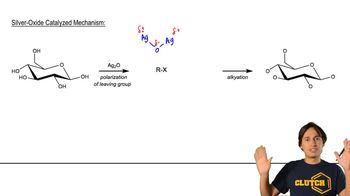
Methyl Iodide as a Methylating Agent

Methyl iodide (CH3I) is a potent methylating agent commonly used in organic synthesis. It can transfer a methyl group to nucleophiles, such as the hydroxyl groups on sugars. In the presence of a base like silver oxide, methyl iodide facilitates the formation of methyl ethers from alcohols, which is crucial for understanding the expected product of the reaction.
Video consigliato:
09:28
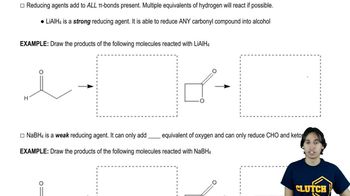
Reducing Agents

Silver Oxide as a Base

Silver oxide (Ag2O) acts as a mild base in organic reactions, promoting the deprotonation of alcohols to form alkoxide ions. This enhances the nucleophilicity of the hydroxyl group in b-D-galactopyranose, making it more reactive towards methyl iodide. Understanding the role of silver oxide is essential for predicting the outcome of the reaction and the stability of the resulting methyl glycoside.
Video consigliato:
03:02
Silver Oxide Catalyzed Mechanism