Ch. 23 - Carbohydrates and Nucleic Acids
Wade - Organic Chemistry 9th Edition
Wade9th EditionOrganic ChemistryISBN: 9780135213728Non è quello che usi tu?Cambia libro di testo
Capitolo 23, Problema 1

Draw the mirror images of glucose and fructose. Are glucose and fructose chiral? Do you expect them to be optically active?

Guida verificata passo dopo passo
1
Step 1: Understand the structures of glucose and fructose. Glucose is an aldohexose (a six-carbon sugar with an aldehyde group), while fructose is a ketohexose (a six-carbon sugar with a ketone group). Both are monosaccharides and have multiple chiral centers.
Step 2: To draw the mirror images of glucose and fructose, invert the configuration of each chiral center in their structures. For example, if a hydroxyl group (-OH) is on the right side in the original structure, place it on the left side in the mirror image.
Step 3: Analyze chirality. A molecule is chiral if it has at least one chiral center and lacks an internal plane of symmetry. Both glucose and fructose have multiple chiral centers, making them chiral molecules.
Step 4: Determine optical activity. Chiral molecules are typically optically active, meaning they can rotate plane-polarized light. Since glucose and fructose are chiral, they are expected to be optically active.
Step 5: Note that the images provided show D-galactose and D-mannose, which are stereoisomers of glucose. These structures can help you understand how to invert configurations to draw mirror images for glucose and fructose.

Risposta video verificata per un problema simile:

Questa soluzione video è stata consigliata dai nostri tutor come utile per risolvere questo problema.
Durata del video:
4m

Concetti chiave

Ecco i concetti essenziali che devi comprendere per rispondere correttamente alla domanda.

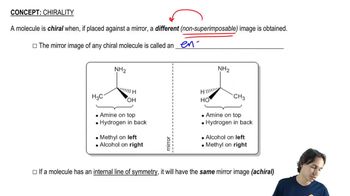
Chirality

Chirality refers to the geometric property of a molecule that makes it non-superimposable on its mirror image. A chiral molecule typically has at least one carbon atom bonded to four different substituents, resulting in two distinct forms known as enantiomers. Glucose and fructose each contain multiple chiral centers, making them chiral compounds.
Video consigliato:
05:10
What is chirality?

Optical Activity

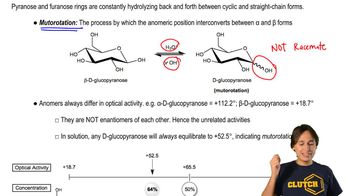
Optical activity is the ability of a chiral compound to rotate the plane of polarized light. This property arises from the asymmetry of chiral molecules, which interact differently with light. Since both glucose and fructose are chiral, they are expected to be optically active, meaning they will rotate polarized light in specific directions.
Video consigliato:
08:17
Mutarotation and Optical Activity

Structural Isomers

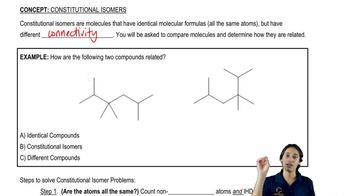
Structural isomers are compounds that have the same molecular formula but differ in the arrangement of atoms. Glucose and fructose are structural isomers of each other, as they both share the formula C6H12O6 but have different structural configurations. Understanding their structural differences is crucial for analyzing their properties, including chirality and optical activity.
Video consigliato:
01:10
What is a constitutional isomer?