
Ch. 23 - Carbohydrates and Nucleic Acids
Wade - Organic Chemistry 9th Edition
Wade9th EditionOrganic ChemistryISBN: 9780135213728Non è quello che usi tu?Cambia libro di testo
Capitolo 23, Problema 37

Give an equation to show the reduction of Tollens reagent by maltose.

Guida verificata passo dopo passo
1
Understand the context: Tollens' reagent is a mild oxidizing agent, typically used to test for the presence of aldehydes. Maltose, a disaccharide, contains a free aldehyde group in its open-chain form, which can reduce Tollens' reagent.
Write the chemical formula for Tollens' reagent: Tollens' reagent contains the diamminesilver(I) ion, [Ag(NH₃)₂]⁺, which is reduced to metallic silver (Ag) during the reaction.
Write the chemical formula for maltose: Maltose is a disaccharide with the molecular formula C₁₂H₂₂O₁₁. In its open-chain form, it has a free aldehyde group (-CHO) that can be oxidized.
Write the reaction: The aldehyde group in maltose is oxidized to a carboxylic acid group (-COOH), while the silver ion in Tollens' reagent is reduced to metallic silver. The reaction can be represented as: C12H22O11(aldehyde)+[Ag(NH3)2]+→C12H22O11(carboxylic)+Ag
Balance the equation: Ensure that the number of atoms and charges are balanced on both sides of the equation. This involves balancing the oxidation of the aldehyde group and the reduction of the silver ion.

Risposta video verificata per un problema simile:

Questa soluzione video è stata consigliata dai nostri tutor come utile per risolvere questo problema.
Durata del video:
2m

Concetti chiave

Ecco i concetti essenziali che devi comprendere per rispondere correttamente alla domanda.

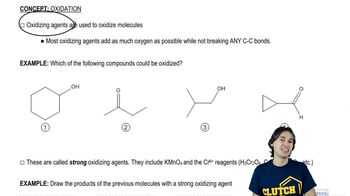
Tollens' Reagent

Tollens' reagent is a solution of silver nitrate (AgNO3) in ammonia, used to test for aldehydes. It contains the complex ion [Ag(NH3)2]+, which can oxidize aldehydes to carboxylic acids while being reduced to metallic silver. This reaction is significant in organic chemistry for identifying reducing sugars, such as maltose.
Video consigliato:
01:52
Reagents

Maltose Structure

Maltose is a disaccharide composed of two glucose units linked by an α(1→4) glycosidic bond. It is a reducing sugar because it has a free aldehyde group that can participate in redox reactions. Understanding maltose's structure is essential for predicting its reactivity with Tollens' reagent.
Video consigliato:
03:04
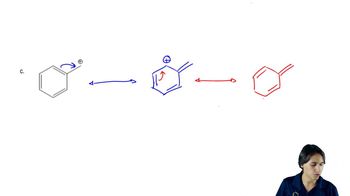
Drawing Resonance Structures

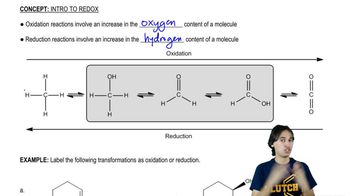
Redox Reactions

Redox reactions involve the transfer of electrons between two species, resulting in oxidation (loss of electrons) and reduction (gain of electrons). In the context of the Tollens' test, maltose acts as a reducing agent, donating electrons to the silver ion in Tollens' reagent, which is reduced to metallic silver, demonstrating the reducing properties of maltose.
Video consigliato:
06:02
General Features of Redox
Pratica correlata
Domanda del libro di testo

In 1891, Emil Fischer determined the structures of glucose and the seven other D-aldohexoses using only simple chemical reactions and clever reasoning about stereochemistry and symmetry. He received the Nobel Prize for this work in 1902. Fischer had determined that D-glucose is an aldohexose, and he used Ruff degradations to degrade it to (+)-glyceraldehyde. Therefore, the eight D-aldohexose structures shown in Figure 23-3 are the possible structures for glucose.

Pretend that no names are shown in Figure 23-3 except for glyceraldehyde, and use the following results to prove which of these structures represent glucose, mannose, arabinose, and erythrose.

(a) Upon Ruff degradation, glucose and mannose give the same aldopentose: arabinose. Nitric acid oxidation of arabinose gives an optically active aldaric acid. What are the two possible structures of arabinose?

896
views
Domanda del libro di testo

Draw the structures of the individual mutarotating α and β anomers of maltose.

927
views
Domanda del libro di testo

Trehalose is a nonreducing disaccharide (C12H22O11) isolated from the poisonous mushroom Amanita muscaria. Treatment with an α-glucosidase converts trehalose to two molecules of glucose, but no reaction occurs when trehalose is treated with a β-glucosidase. When trehalose is methylated by dimethyl sulfate in mild base and then hydrolyzed, the only product is 2,3,4,6-tetra-O-methylglucose. Propose a complete structure and systematic name for trehalose.

670
views
Domanda del libro di testo

Is gentiobiose a reducing sugar? Does it mutarotate? Explain your reasoning

1481
views
Domanda del libro di testo

In 1891, Emil Fischer determined the structures of glucose and the seven other D-aldohexoses using only simple chemical reactions and clever reasoning about stereochemistry and symmetry. He received the Nobel Prize for this work in 1902. Fischer had determined that D-glucose is an aldohexose, and he used Ruff degradations to degrade it to (+)-glyceraldehyde. Therefore, the eight D-aldohexose structures shown in Figure 23-3 are the possible structures for glucose.

Pretend that no names are shown in Figure 23-3 except for glyceraldehyde, and use the following results to prove which of these structures represent glucose, mannose, arabinose, and erythrose.

(b) Upon Ruff degradation, arabinose gives the aldotetrose erythrose. Nitric acid oxidation of erythrose gives an optically inactive aldaric acid, meso-tartaric acid. What is the structure of erythrose?

821
views
Domanda del libro di testo

Does lactose mutarotate? Is it a reducing sugar? Explain. Draw the two anomeric forms of lactose

876
views