Ch. 24 - Amino Acids, Peptides, and Proteins
Wade - Organic Chemistry 9th Edition
Wade9th EditionOrganic ChemistryISBN: 9780135213728Non è quello che usi tu?Cambia libro di testo
Capitolo 24, Problema 29g

Predict the products of the following reactions.
(g) 4-methylpentanoic acid + Br2/PBr3 →

Guida verificata passo dopo passo
1
Identify the type of reaction: The presence of Br2 and PBr3 suggests that this is a Hell-Volhard-Zelinsky (HVZ) reaction, which is specific to carboxylic acids. This reaction involves the alpha-bromination of the carboxylic acid.
Understand the mechanism: In the HVZ reaction, PBr3 first converts the carboxylic acid group (-COOH) into an acyl bromide (-COBr). This intermediate is more reactive and facilitates the subsequent steps.
Determine the alpha-bromination step: The acyl bromide undergoes enolization (formation of an enol intermediate) at the alpha-carbon (the carbon adjacent to the carbonyl group). The enol reacts with Br2, leading to the substitution of a hydrogen atom at the alpha-carbon with a bromine atom.
Account for the final product: After the alpha-bromination, the acyl bromide intermediate is hydrolyzed back to the carboxylic acid, regenerating the -COOH group while retaining the bromine atom at the alpha-carbon.
Write the product structure: The final product is 2-bromo-4-methylpentanoic acid, where the bromine atom is attached to the alpha-carbon of the original carboxylic acid.

Risposta video verificata per un problema simile:

Questa soluzione video è stata consigliata dai nostri tutor come utile per risolvere questo problema.
Durata del video:
1m

Concetti chiave

Ecco i concetti essenziali che devi comprendere per rispondere correttamente alla domanda.

Reactivity of Carboxylic Acids

Carboxylic acids, such as 4-methylpentanoic acid, are characterized by the presence of the carboxyl group (-COOH). This functional group is highly reactive, particularly in nucleophilic substitution reactions. Understanding how carboxylic acids react with halogens is crucial for predicting the products of the given reaction.
Video consigliato:
04:20
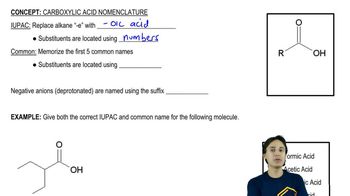
Carboxylic Acids Nomenclature

Halogenation Reactions

Halogenation involves the introduction of halogen atoms into organic compounds. In the presence of Br2 and PBr3, carboxylic acids can undergo halogenation at the alpha position (the carbon adjacent to the carboxyl group). This process is essential for predicting the products of the reaction involving 4-methylpentanoic acid.
Video consigliato:
03:45
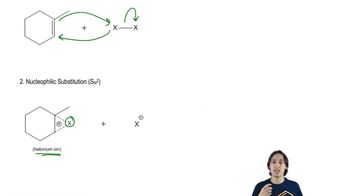
Halogenation Mechanism

Mechanism of Nucleophilic Substitution

Nucleophilic substitution is a fundamental reaction mechanism in organic chemistry where a nucleophile replaces a leaving group in a molecule. In the context of the reaction with 4-methylpentanoic acid, understanding the mechanism helps in predicting how the bromine will be incorporated into the molecule, leading to the formation of the final product.
Video consigliato:
01:47
Nucleophiles and Electrophiles can react in Substitution Reactions.