
Ch. 24 - Amino Acids, Peptides, and Proteins
Wade - Organic Chemistry 9th Edition
Wade9th EditionOrganic ChemistryISBN: 9780135213728Non è quello che usi tu?Cambia libro di testo
Capitolo 24, Problema 48d,e

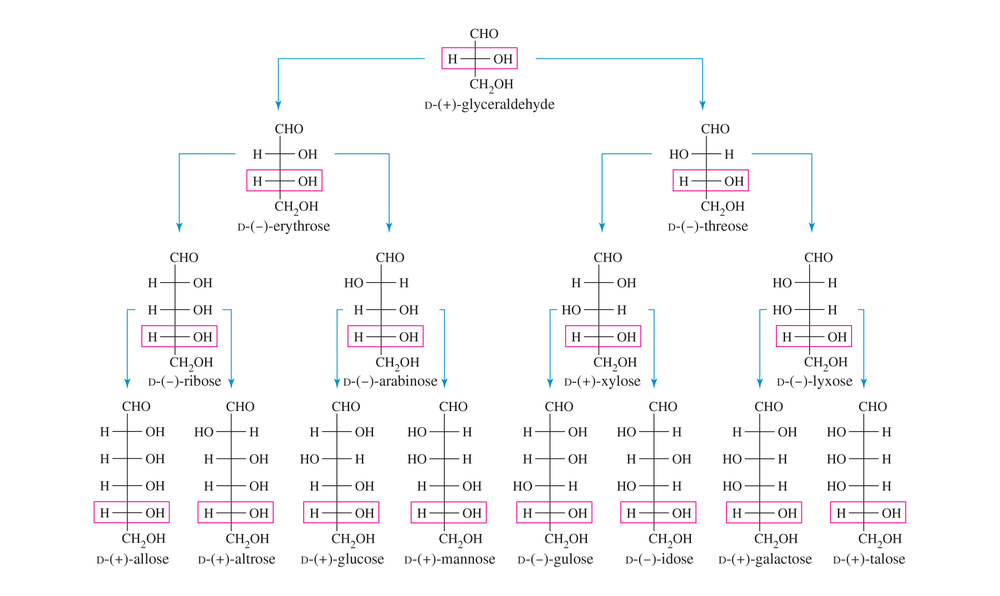
Use Figure 23-3 (the D family of aldoses) to name the following aldoses.
(d) the enantiomer of D-galactose
(e) the C5 epimer of D-glucose
Diagram of aldoses showing D-glyceraldehyde and its enantiomers, including D-galactose and C5 epimer of D-glucose.

Guida verificata passo dopo passo
1
Identify the structure of D-galactose from Figure 23-3. D-galactose is an aldohexose with the specific configuration of hydroxyl groups on its chiral centers.
To find the enantiomer of D-galactose, invert the configuration at every chiral center. This means if a hydroxyl group is on the right in D-galactose, it should be on the left in its enantiomer, and vice versa.
Name the enantiomer of D-galactose. Since enantiomers are mirror images, the enantiomer of D-galactose is L-galactose.
Identify the structure of D-glucose from Figure 23-3. D-glucose is also an aldohexose with its own specific configuration of hydroxyl groups.
To find the C5 epimer of D-glucose, change the configuration of the hydroxyl group at the C5 position only, while keeping the rest of the molecule the same. The C5 epimer of D-glucose is D-mannose.

Risposta video verificata per un problema simile:

Questa soluzione video è stata consigliata dai nostri tutor come utile per risolvere questo problema.
Durata del video:
4m

Concetti chiave

Ecco i concetti essenziali che devi comprendere per rispondere correttamente alla domanda.

Aldoses

Aldoses are a type of monosaccharide characterized by the presence of an aldehyde group (-CHO) at one end of the molecule. They can exist in various forms, including D and L configurations, which refer to the orientation of the hydroxyl group on the chiral carbon farthest from the aldehyde. Understanding aldoses is crucial for identifying their structural relationships and naming conventions.
Video consigliato:
03:21
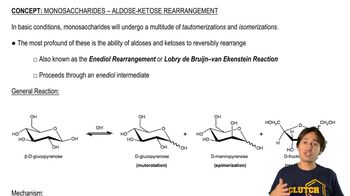
General Reaction

Enantiomers

Enantiomers are a pair of molecules that are non-superimposable mirror images of each other. In the context of sugars, D-galactose and its enantiomer, L-galactose, differ in the configuration around all chiral centers. Recognizing enantiomers is essential for naming aldoses correctly, as it affects their biochemical properties and interactions.
Video consigliato:
03:23
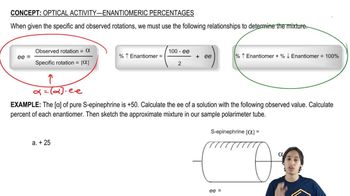
How to solve for the percentage of each enantiomer.

Epimers

Epimers are a specific type of diastereomer that differ in configuration at only one of several chiral centers. For example, D-glucose and D-mannose are C2 epimers, while D-glucose and D-galactose are C4 epimers. Identifying epimers is important for understanding the structural diversity of sugars and their relationships, particularly when naming aldoses based on their stereochemistry.
Video consigliato:
03:42
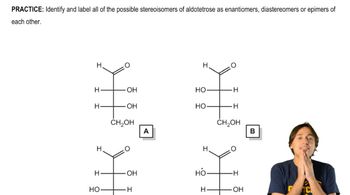
Identifying Types of Stereoisomers