

Ch. 7 - Structure and Synthesis of Alkenes; Elimination
Wade - Organic Chemistry 9th Edition
Wade9th EditionOrganic ChemistryISBN: 9780135213728Non è quello che usi tu?Cambia libro di testo
Capitolo 7, Problema 49c

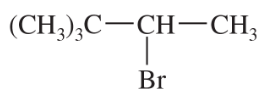
Predict the products of E1 elimination of the following compounds. Label the major products.
(c)

Guida verificata passo dopo passo
1
Step 1: Understand the E1 elimination mechanism. E1 elimination involves two steps: (1) the leaving group departs, forming a carbocation intermediate, and (2) a proton is removed from a β-carbon by a base, resulting in the formation of a double bond. The reaction typically favors the formation of the most stable alkene (Zaitsev's rule).
Step 2: Identify the structure of the given compound, (CH3)3C-CH(CH3)Br. The molecule consists of a tertiary carbon bonded to a bromine atom (the leaving group) and a secondary carbon with a methyl group attached.
Step 3: Determine the carbocation intermediate. When the bromine leaves, a tertiary carbocation forms at the central carbon atom (C1), as tertiary carbocations are more stable due to hyperconjugation and inductive effects.
Step 4: Analyze the β-hydrogens available for elimination. The β-carbons are adjacent to the carbocation (C2 and C3). C2 has one hydrogen atom, and C3 has three hydrogen atoms. Removing a β-hydrogen from either carbon will result in the formation of a double bond.
Step 5: Apply Zaitsev's rule to predict the major product. Zaitsev's rule states that the most substituted alkene is the major product. Removing a β-hydrogen from C2 will form a double bond between C1 and C2, resulting in a more substituted alkene compared to removing a β-hydrogen from C3. Label the alkene formed by elimination at C2 as the major product.

Risposta video verificata per un problema simile:

Questa soluzione video è stata consigliata dai nostri tutor come utile per risolvere questo problema.
Durata del video:
6m

Concetti chiave

Ecco i concetti essenziali che devi comprendere per rispondere correttamente alla domanda.

E1 Elimination Mechanism

The E1 elimination mechanism involves two main steps: the formation of a carbocation intermediate after the leaving group departs, followed by the removal of a proton to form a double bond. This mechanism is favored in tertiary substrates due to their ability to stabilize the carbocation, leading to the formation of alkenes as products.
Video consigliato:
08:09
Drawing the E1 Mechanism.

Carbocation Stability

Carbocation stability is crucial in determining the pathway of elimination reactions. Tertiary carbocations are more stable than secondary or primary ones due to hyperconjugation and inductive effects from surrounding alkyl groups. In the given compound, the formation of a tertiary carbocation will significantly influence the major product of the E1 reaction.
Video consigliato:
05:58
Determining Carbocation Stability

Zaitsev's Rule

Zaitsev's Rule states that in elimination reactions, the more substituted alkene is typically the major product. This is because more substituted alkenes are generally more stable due to hyperconjugation and steric factors. When predicting the products of the E1 elimination for the given compound, identifying the more substituted alkene will help in labeling the major product.
Video consigliato:
01:18
Defining Zaitsev’s Rule
Pratica correlata
Domanda del libro di testo

A double bond in a six-membered ring is usually more stable in an endocyclic position than in an exocyclic position. Hydrogenation data on two pairs of compounds follow. One pair suggests that the energy difference between endocyclic and exocyclic double bonds is about 9 kJ/mol. The other pair suggests an energy difference of about 5 kJ/mol. Which number do you trust as being more representative of the actual energy difference? Explain your answer.

4487
views
1
comments
Domanda del libro di testo

Predict the products of E1 elimination of the following compounds. Label the major products.

(a)

751
views
Domanda del libro di testo

Predict the products formed by sodium hydroxide-promoted dehydrohalogenation of the following compounds. In each case, predict which will be the major product.

d. cis-1-bromo-2-methylcyclohexane

616
views
Domanda del libro di testo

Predict the products formed by sodium hydroxide-promoted dehydrohalogenation of the following compounds. In each case, predict which will be the major product.

a. 1-bromobutane

b. 2-chlorobutane

c. 3-bromopentane

1041
views
Domanda del libro di testo

The energy difference between cis- and trans-but-2-ene is about 4 kJ/mol; however, the trans isomer of 4,4-dimethylpent-2-ene is nearly 16 kJ/mol more stable than the cis isomer. Explain this large difference.

2169
views
Domanda del libro di testo

Predict the products formed by sodium hydroxide-promoted dehydrohalogenation of the following compounds. In each case, predict which will be the major product.

e. trans-1-bromo-2-methylcyclohexane

668
views