Ch.8 - Reactions of Alkenes
Wade - Organic Chemistry 9th Edition
Wade9th EditionOrganic ChemistryISBN: 9780135213728Non è quello che usi tu?Cambia libro di testo
Capitolo 8, Problema 70b

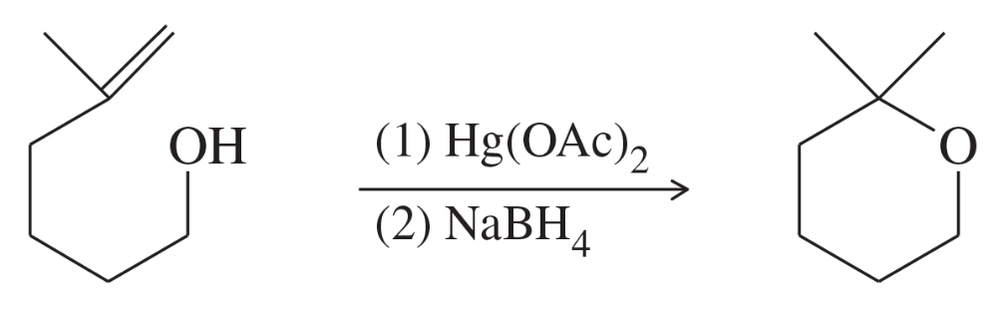
Predict the product of formula C7H13BrO from the reaction of this same unsaturated alcohol with bromine. Propose a mechanism to support your prediction.

Guida verificata passo dopo passo
1
Step 1: Analyze the structure of the given unsaturated alcohol. The molecule contains a double bond (C=C) and a hydroxyl group (-OH). The double bond is the reactive site for bromine addition.
Step 2: Recall the reaction mechanism for bromine addition to alkenes. Bromine (Br2) reacts with the double bond via an electrophilic addition mechanism. The π-electrons of the double bond attack the bromine molecule, forming a bromonium ion intermediate.
Step 3: Propose the mechanism. The bromine molecule approaches the double bond, and one bromine atom becomes electrophilic. The π-electrons of the double bond attack this bromine atom, leading to the formation of a cyclic bromonium ion intermediate.
Step 4: Explain the nucleophilic attack. The second bromine atom (Br⁻) acts as a nucleophile and attacks the more substituted carbon of the bromonium ion, leading to the anti-addition of bromine across the double bond.
Step 5: Predict the product. The final product will be a dibromo compound with the bromine atoms added anti to each other across the double bond. The hydroxyl group (-OH) remains unchanged in the molecule.

Risposta video verificata per un problema simile:

Questa soluzione video è stata consigliata dai nostri tutor come utile per risolvere questo problema.
Durata del video:
7m

Concetti chiave

Ecco i concetti essenziali che devi comprendere per rispondere correttamente alla domanda.

Unsaturated Alcohols

Unsaturated alcohols contain one or more carbon-carbon double bonds (alkenes) along with a hydroxyl (-OH) group. The presence of the double bond makes them reactive, particularly in electrophilic addition reactions. Understanding the structure and reactivity of unsaturated alcohols is crucial for predicting the products of their reactions, such as with bromine.
Video consigliato:
02:39
The difference between saturated and unsaturated molecules.

Electrophilic Addition Mechanism

The electrophilic addition mechanism involves the reaction of an electrophile with a nucleophile, leading to the formation of a more saturated product. In the case of bromine reacting with an unsaturated alcohol, the double bond acts as a nucleophile, attacking the bromine molecule, which results in the formation of a bromonium ion intermediate. This step is essential for understanding how the final product is formed.
Video consigliato:
05:39
Features of Addition Mechanisms.

Halohydrin Formation

Halohydrin formation occurs when an alkene reacts with a halogen (like bromine) in the presence of water or an alcohol, resulting in the addition of both a halogen and a hydroxyl group across the double bond. This reaction typically proceeds through a bromonium ion intermediate, leading to the formation of a product that contains both a halogen and an alcohol functional group, which is relevant for predicting the product of the given reaction.
Video consigliato:
01:44
General properties of halohydrin formation.
Pratica correlata
Domanda del libro di testo

Propose a mechanism for reaction of the first three propylene units in the polymerization of propylene in the presence of a peroxide.

1694
views

Domanda del libro di testo

When styrene (vinylbenzene) is commercially polymerized, about 1–3% of 1,4-divinylbenzene is often added to the styrene. The incorporation of some divinylbenzene gives a polymer with more strength and better resistance to organic solvents. Explain how a very small amount of divinylbenzene has a marked effect on the properties of the polymer.

1427
views
Domanda del libro di testo

An unknown compound decolorizes bromine in carbon tetrachloride, and it undergoes catalytic reduction to give decalin. When treated with warm, concentrated potassium permanganate, this compound gives cis-cyclohexane-1,2-dicarboxylic acid and oxalic acid. Propose a structure for the unknown compound.

1089
views
Domanda del libro di testo

The following cyclization has been observed in the oxymercuration-demercuration of this unsaturated alcohol. Propose a mechanism for this reaction.

1641
views
1
rank
Domanda del libro di testo

The two butenedioic acids are called fumaric acid (trans) and maleic acid (cis). 2,3-Dihydroxybutanedioic acid is called tartaric acid.

Show how you would convert

c. maleic acid to (±)-tartaric acid.

2089
views
Domanda del libro di testo

A graduate student attempted to form the iodohydrin of the alkene shown below. Her analysis of the products showed a good yield of an unexpected product. Propose a mechanism to explain the formation of this product.

1003
views