


Ch.8 - Reactions of Alkenes
Wade - Organic Chemistry 9th Edition
Wade9th EditionOrganic ChemistryISBN: 9780135213728Non è quello che usi tu?Cambia libro di testo
Capitolo 8, Problema 55b

Following the instructions for drawing the energy levels of the molecular orbitals for the compounds shown in [Figure 8.17], draw the energy levels of the molecular orbitals for the cycloheptatrienyl cation. For each compound, show the distribution of the π\(\pi\) electrons. Which of the compounds are aromatic?

Guida verificata passo dopo passo
1
Step 1: Begin by identifying the molecular structure of the cyclopropenyl cation. The cyclopropenyl cation is a three-membered ring with one positive charge and two π-electrons. This is important because the number of π-electrons will determine its aromaticity based on Hückel's rule.
Step 2: Apply Hückel's rule for aromaticity. Hückel's rule states that a compound is aromatic if it has a planar, cyclic structure with (4n + 2) π-electrons, where n is a non-negative integer. For the cyclopropenyl cation, count the π-electrons (2 π-electrons in this case) and check if they satisfy the (4n + 2) rule.
Step 3: Draw the molecular orbital (MO) diagram for the cyclopropenyl cation. Start by noting that the cyclopropenyl cation has three atomic p orbitals (one from each carbon atom) that combine to form three molecular orbitals: one bonding orbital, one non-bonding orbital, and one anti-bonding orbital. Arrange these orbitals in terms of energy levels, with the bonding orbital being the lowest in energy, the non-bonding orbital in the middle, and the anti-bonding orbital being the highest.
Step 4: Populate the molecular orbitals with the π-electrons. Since the cyclopropenyl cation has 2 π-electrons, place them in the lowest energy bonding orbital according to the Aufbau principle (fill lower energy orbitals first). This will leave the non-bonding and anti-bonding orbitals unoccupied.
Step 5: Determine the aromaticity of the cyclopropenyl cation. Since the molecule is cyclic, planar, and has 2 π-electrons (which satisfies the (4n + 2) rule with n = 0), the cyclopropenyl cation is aromatic. Confirm this by noting the delocalization of π-electrons across the ring, which contributes to its stability.

Risposta video verificata per un problema simile:

Questa soluzione video è stata consigliata dai nostri tutor come utile per risolvere questo problema.
Durata del video:
3m

Concetti chiave

Ecco i concetti essenziali che devi comprendere per rispondere correttamente alla domanda.

Molecular Orbitals

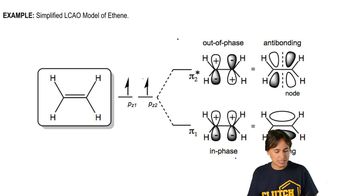
Molecular orbitals (MOs) are formed by the linear combination of atomic orbitals (LCAO) and describe the behavior of electrons in a molecule. In the context of the cyclopropenyl cation, understanding how these orbitals are filled and how they interact is crucial for determining the stability and reactivity of the compound. The arrangement of electrons in these orbitals influences the overall energy levels and can indicate whether a molecule is aromatic.
Video consigliato:
08:41
Review of Molecular Orbitals

Aromaticity

Aromaticity is a property of cyclic compounds that exhibit enhanced stability due to the delocalization of π electrons across the ring structure. For a compound to be considered aromatic, it must satisfy Hückel's rule, which states that it should have a planar structure, be cyclic, and contain a total of 4n + 2 π electrons, where n is a non-negative integer. Identifying whether the cyclopropenyl cation is aromatic involves analyzing its electron count and structure.
Video consigliato:
08:19
Intro to Aromaticity

Electron Distribution

Electron distribution refers to how electrons are arranged in molecular orbitals and how they contribute to the overall electronic structure of a molecule. In the case of the cyclopropenyl cation, understanding the distribution of p electrons is essential for visualizing the bonding and stability of the compound. This distribution can be represented in energy level diagrams, which help in assessing the compound's reactivity and aromatic character.
Video consigliato:
03:54
The 18 and 16 Electron Rule